Why gold isn’t exploding despite war
The Iran conflict triggered market volatility, but the precious metal’s muted response reveals deeper macro forces at play
By
Prefer us on GoogleLast Updated: Mar 05, 2026, 17:05 IST5 min
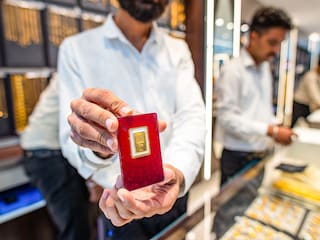
When coordinated US and Israeli strikes hit Iran on February 28, markets reacted the way they typically do in geopolitical crises: Equities slid, currencies weakened and commodity prices jumped.
Gold rose about 2.15 percent in the immediate aftermath, while silver climbed 1.63 percent, according to Shriram Wealth’s Macro & Market update for March. But the surge fell short of the explosive rally many investors had anticipated. Some traders had been betting that gold would climb as high as Rs2 lakh per 10 grams in India, a milestone the market hasn’t come close to reaching.
“The frenzy people expected hasn’t happened,” says Saurabh Gadgil, chairman and managing director, PNG Jewellers. “Many thought gold would touch Rs1.75-1.8 lakh, but that excitement has subsided, and the market is in a wait-and-watch mode.”
Surendra Mehta, national secretary of the India Bullion and Jewellers Association Ltd, says gold has seen strong resistance beyond $5,400 in the spot market despite the war situation. “This is not a good sign for gold at present as it seems gold is being sold off to buy arms and ammunition by a few small countries to protect themselves.”
Without a break beyond $5,474, Mehta believes the metal will remain range-bound.
That same pattern appeared after the latest escalation in West Asia.
“When the war broke out over the weekend, there was a lot of interest to buy bullion—primarily gold—as an investment given the uncertainty ahead,” says Gadgil. “But most jewellers were only selling what they had in stock because the markets were closed and we couldn’t hedge fresh bookings. So, there was a lot of pent-up demand.”
ETF platforms saw the same behaviour.
Transactions in gold and silver mutual funds on Stable Money’s platform jumped nearly threefold compared with the previous day, says co-founder Saurabh Jain. “This kind of spike reflects a clear risk-off shift in investor behaviour marked by sharp reallocations,” he adds. “Investors often reduce exposure to equities and move toward assets perceived as more stable such as fixed deposits and regulated precious metal funds.”
But the rally lost momentum almost as quickly as it began.
Gold had been climbing steadily even before the conflict, supported by central bank buying and currency weakness. When the escalation happened, traders had already priced in much of the geopolitical risk.
Then oil began to steal the spotlight.
“Gold corrected by almost Rs5,000 after some of the pent-up demand was fulfilled on Monday because there was margin pressure on COMEX. A lot of investors shifted from gold futures to crude futures as oil started rallying,” says Gadgil of PNG, the Rs7,181-crore market cap jeweller.
Oil often reacts faster than gold in conflicts because of its direct exposure to geopolitical supply disruptions. The Strait of Hormuz alone carries roughly 20 percent of the world’s oil supply, making it a crucial chokepoint when tensions flare in the Gulf region.
“Gold will see more buying interest than silver as gold is considered more of a safe haven,” says Manav Modi, commodities analyst at Motilal Oswal Financial Services.Silver has both precious metal and industrial characteristics, which makes it more price-sensitive and comparatively erratic.
Nearly 60 percent of silver demand comes from industrial applications and so war leading to an industrial slowdown could cap silver’s gains. “If we see escalations, riskier assets, including industrial metals like copper and silver, could see limited gains,” Modi says.
Industry data shows gold ETF inflows outpacing silver by a meaningful margin, reflecting its deeper liquidity and stronger safe-haven positioning.
“Silver ETFs have also seen healthy participation, but volumes tend to be smaller and more volatile relative to gold,” says Stable Money’s Jain.
“Correlations shift with macro regimes,” says Bhavik Joshi, business head at INVasset PMS. “This cycle has not been about gold rallying in isolation. It has been a combination of currency weakness, sovereign reserve reallocation and steady liquidity conditions.”
When real interest rates remain contained and fiscal deficits remain high, both asset classes can rise together.
The rupee weakened nearly 5 percent in 2025, breaching Rs91 per dollar at one point amid foreign portfolio outflows and global currency volatility.
When the dollar strengthens, gold becomes more expensive in rupee terms even if the international price remains stable.
That dynamic partly explains the sharp rise in domestic prices.
Data shows that gold prices climbed from around Rs81,798 per 10 grams at the start of 2025 to Rs1,32,640 by December, while silver prices surged from roughly Rs93,196 per kilogram to Rs2,29,452 during the same period.
To contextualise the staggering price climb, one needs to only look at a viral comparison by industrialist Harsh Goenka.
In 1990, 1kg of gold could buy you a Maruti 800. By 2010, it was worth a Toyota Fortuner. In 2025, that same kilogram of gold is equivalent to a Land Rover, he suggested in a post on X.
Joshi notes that while the comparison is more of a narrative illustration, it captures the erosion of purchasing power. It isn’t just that gold is getting more expensive, it’s that the currency used to buy it is buying less and less of everything else over decades.
“Gold’s trajectory has been influenced by real interest rate cycles, dollar movements, central bank reserve diversification and global liquidity phases,” he adds.
Until then, gold remains in a tug-of-war between its role as a geopolitical hedge and the immediate liquidity needs of a world at war. As Samit Guha, MD and CEO of MMTC-PAMP, suggests, “In times of uncertainties, investors automatically shift to safe-haven assets... long-term investors should stay aligned with their broader asset allocation strategy.”
First Published: Mar 05, 2026, 17:17
Subscribe Now