This was a fundamental part of affirming the way we saw our role in the world—of creating this bridge between cultures, ideas and people. Students can start their MBA in Asia and move to Fontainebleau (France) or switch around. This opportunity will continue to strengthen because of the significant development trajectory that continues to exist in Asia.
The other part that is quite meaningful is to make sure that we use this presence in Asia to contribute to this better understanding in an environment where the world is becoming a little bit more polarised. We went from a paradigm where people were thinking that the world was going to become flatter. It is clear that that's not the direction we're going in. And so, we're going to have valleys and mountains, and the way to deal with them is through bridges.
We also want to develop an intellectual agenda that leverages our presence in Asia, and I’ll give you two examples of that. One is considering what’s happening with AI—the world often gets stuck between knowing what’s happening in the US and in China, but there’s a whole world beyond that. India is a big part of that story.
We're also committed to developing understanding around the growing relevance of private capital. Though we see that everywhere around the world, it has a distinct set of characteristics in Asia, with the rise of family offices, the importance of investment driven by the private sector. We want to make sure that we understand that and help shape the ecosystem through our intellectual leadership and executive education.
Q. In an increasingly polarised world, what would you say the role of a global university like yours is?
It's precisely that ability to connect, as people become more insular. I’ll take it back to our original identity. When Insead was created in 1957, the idea was we would bring cutting-edge management education to Europe, but also that Insead could contribute to strengthening the peace trajectory in Europe, following, of course, the devastating World War where Europe was the epicentre. That is through understanding and connection, because people were further apart, and there was a lot of rebuilding to be done.
In our student body, there is no one dominant culture. Diversity is a big part of the experience. An important part of our contribution to the world will be to bring people that have understanding of different cultures, understanding of nuance, and the toolkit to navigate in these times. We’re training the next generation of leaders, and this is the specific skillset that the MBA programme brings.
Q. You’re looking to expand in the US. People in India are nervous about higher education in the US now, because of the government’s changing policies towards foreign students. What does this mean for a school like yours?
We don’t offer degree programmes in the US yet, but we have a hub in San Francisco and a long-standing partnership with Wharton. However, we are a business school for the world, and the US is, of course, a big part of that, as is Asia. We want to build a stronger presence there, and we have a few ideas, but we are paying attention to the latest developments.
At the moment, we have not seen any meaningful movement, in terms of student applications and enrollment. I had a meeting with deans of several other leading business schools in Europe during the summer, and the picture that emerged out of the first few months seemed to be relatively consistent—which is some movement on the undergraduates, which is in line with the points you made. With undergraduates, younger parents are worried, saying, ‘I don't want my son or my daughter to be in a difficult situation in the US’. They are a little bit more concerned about graduate education there, which pertains to adults pursuing professional careers, who may consider that, you know, every place has trade-offs.
We're all curious about what's going to happen this year. When some of these challenging decisions and situations started to happen, a lot of the application processes were in their final stages last year. By January, when second rounds of applications are going to be closing across graduate business schools around the world, including ours, we will start to have a clearer picture of how it is playing out.
Q. In an environment like this, what would you say is the role of business education?
Business education today, I would say, is more meaningful than it has ever been. It is also shifting, changing in important ways. As I said, we're in the business of training leaders, and leaders need to be prepared to navigate these treacherous times, but also an environment with an amazing set of opportunities.
If we go back to previous rocky periods, that's when a lot of innovation took place. The financial crisis of 2008-2009—that's when WhatsApp was created. That's when Facebook, Uber took off. Periods of uncertainty and periods of change are also periods of fundamental transformation.
So, for us at Insead, it means making sure we are at the cutting edge of understanding how these transformations are taking place, be it on the supply chains, structures side because of trade barriers and other aspects, or on the technical side, understanding how AI is shaping processes, systems, teams. We need to make sure that we double down on having our academics at the forefront of understanding that, so that we can bring it to the classroom, and effectively contribute to preparing this new generation of leaders.
![]()
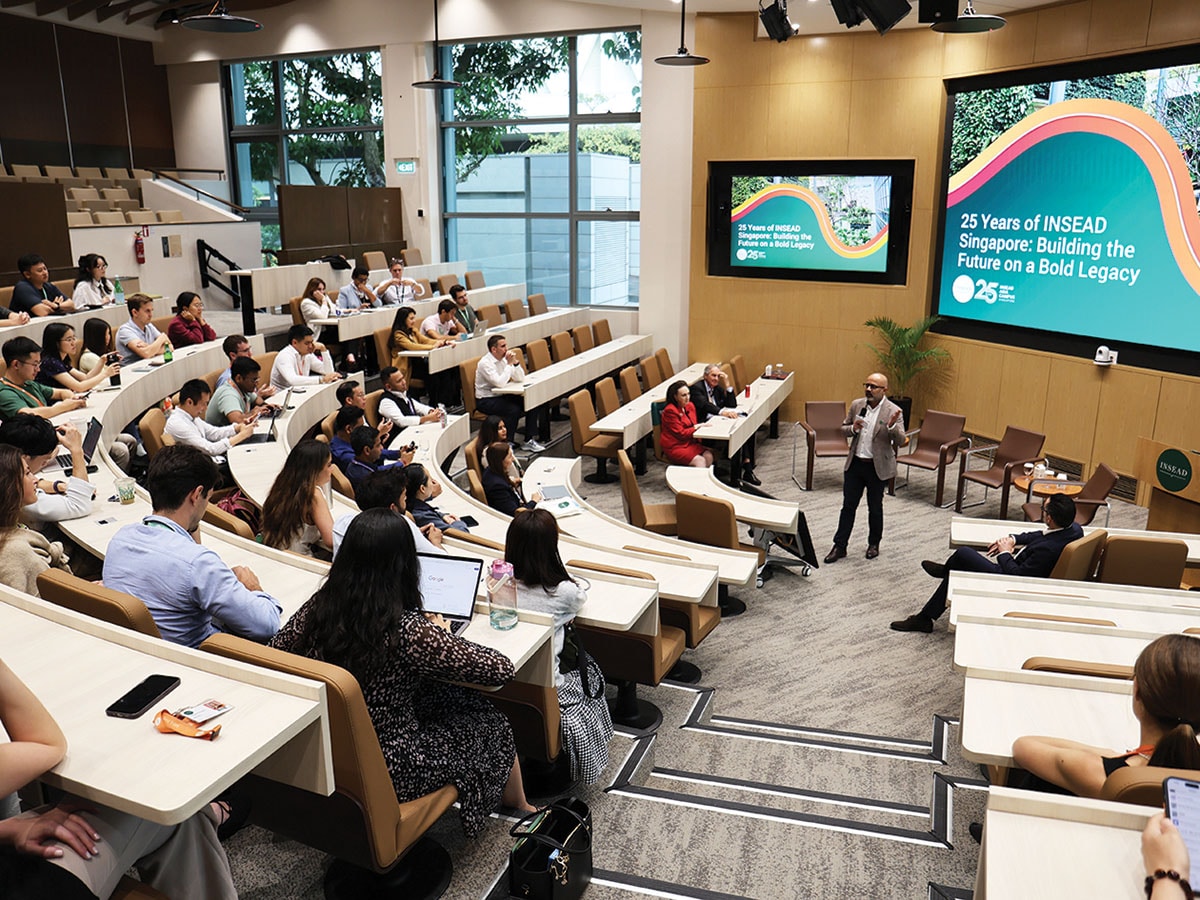
Insead set up its Singapore campus in 2000;
Photo courtesy Insead
Q. Has AI changed the university application process, which relies heavily on students’ personal essays?
Essays for us are an important force. But I would say it's only one component. What we want through the essays is fundamental—a way for the person to be reflective about their journey, especially for the MBA.
The average student applies for the MBA when they’re 27, 28 years old. So, what we ask of the essays is for them to reflect on their professional trajectory. And so, while your favourite LLM [large language model] may make sure that you have a good narrative, that you explain things well, it's still fundamentally about what you did and why you did it, what you felt and what you learnt. No LLM could tell me what I learnt. We also have standardised test scores, which take place in controlled environments, and interviews conducted by our faculty and alumni. It’s a robust process that goes beyond the essays.
I can see how this is a larger problem for undergraduate education, where many high school students with good grades have similar trajectories. Schools might decide to go back to more time and resource-intensive methods, such as interviews in person.
Q. Where does India stand in Insead’s global strategy? What trends have you observed among Indian students?
India is an absolutely central market. Not only is it the most represented population in our community no matter what slice you take, whether students or faculty, it’s also one of the top five countries globally for our custom programmes. These are programmes that we work with individual companies to design, tailored to their needs. This is an important aspect for us.
That’s from the point of our activity. But in my view, and in that of the school, India is also a very important actor globally. Not only because of its amazing economic trajectory; it's also probably, together with Europe, one of the only countries that can help the world not be dominated by the polarisation of China versus the US. We need strong actors that show the world that it goes beyond that.
We want to be part of the India story today and in the future, because the strength of India is good for the world. It’s also interesting, as a lot of successful families in India are creating family offices. These family offices are very well connected to both the Middle East and Singapore, where our campuses are, because those are important routes by which both deploy and mobilise capital.
India is important for the world, and it’s important for us. That’s why we are and will continue to be engaged here, hopefully both learning from and contributing to this trajectory.
There's amazing innovation… that India is at the forefront of the digital side, in so many different dimensions, and this is an important story to be amplified to the world. We can be one of the vehicles of that amplification. I'm happy to do so, because that's how we learn, and how we are able to relay a multi-dimensional view of the world that's not just dominated by two or three narratives, because we know that's not the way the world works.