Maduro falls, oil keeps calm
The Venezuelan president’s dramatic capture barely registers in Indian and global oil markets as decades of decline has erased the country’s energy clout
Last Updated: Jan 09, 2026, 14:28 IST3 min
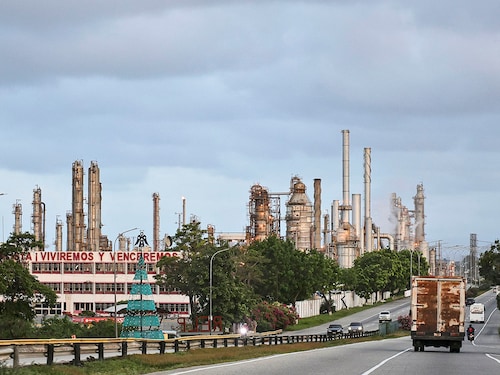
Despite the high stakes capture of Venezuelan President Nicolas Maduro by US forces, the geopolitical shock caused little more than a ripple in the Indian and global oil markets.
Brent crude, the international benchmark, saw a modest 2 percent uptick on January 5 before settling back. WTI, the US equivalent, followed a similar trajectory and stayed under $60 per barrel.
Madan Sabnavis, chief economist at Bank of Baroda, notes that when the Indian markets opened after the weekend operation, they followed a predictable risk-off script—stocks down, yields up and the rupee weakening—yet crude prices and NYMEX futures declined, in a break from historical precedent. He found it striking considering how prices surged even when the US struck Iran despite that country having negligible supply. Gold and silver, however, gained predictably.
Also Read: Trade And Business Trends: What to expect in 2026
India’s energy security remains largely insulated from any fallout of the Caracas operation. Years of active diversification and the US sanctions had already dwindled oil imports to less than 1 percent of India’s crude basket. India’s move to de-risk its supply chain is evident in the numbers: Venezuelan imports have plummeted by over 70 percent since FY19. And at just under $2 billion in FY25, Caracas makes up a negligible sliver of India’s overall merchandise imports.

Moreover, Venezuela’s weak crude output was unlikely to rattle an oil market already defined by significant oversupply. The broader market context explains much of the subdued response. As of January, global crude benchmarks have declined by 20 percent compared to a year ago. OPEC has ramped up production under pressure from the Trump administration; while the US Energy Information Administration expects brent crude to average at $52 per barrel in 2026, reflecting expectations of continued downward pressure on prices.
Most analysts also anticipate muted volatility in the short term. Jim Burkhard, vice president and global head of crude oil research at S&P Global Energy, expects the 2026 forecast for brent to average at $60 per barrel, while Prashant Vashisht, senior vice president, ICRA, does not expect a price shock anytime soon. “So as far as India is concerned, we are insulated for now,” he says. Debasish Mishra, chief growth officer, Deloitte South Asia, says even a sanctions relief is unlikely to significantly move the needle on crude oil prices.
It wasn’t just sanctions that crippled PDVSA, the Venezuelan state oil company. It was years of underinvestment, corruption, brain drain and disastrous operational decisions in a country with reportedly one of the largest oil reserves in the world. Venezuela was pumping just about a million barrels of oil a day as of November—a third of its peak production output of about 3 million barrels daily in the 2000s.
The reality is that any significant return of Venezuelan oil will be a long, arduous process. Investment will be cautious, demanding political stability, legal certainty and clear frameworks for foreign companies.
“The nation’s oil infrastructure requires an estimated $100 billion in long-term investment to return to historical production peaks,” says Deepak Mahurkar, partner at PwC India. He explains that even in the most optimistic scenario where the US prioritises infrastructural rebuilding and economic stabilisation in Venezuela, any significant “unlocking” of Venezuelan reserves for the global market is likely deferred by at least five to seven years.
The 2007 nationalisation of Venezuelan oil sector drove out major US companies like ExxonMobil and ConocoPhillips. While majors like Chevron and Total survived, the current transition aims to bring the exiled giants back into the Venezuelan fold.
Analysts believe that a potential US-led restructuring and revitalising of the Venezuelan oil industry could potentially facilitate the return of nearly $500 million in frozen dividends and unpaid dues to India in a glimmer of hope for ONGC Videsh’s stranded assets.
An oil revival in Caracas would see Indian refiners aggressively targeting heavy-sour barrels to boost margins. According to Vashisht, Indian refiners “have the ability to process such crudes”.
First Published: Jan 09, 2026, 14:34
Subscribe Now