US Supreme Court skips tariff ruling again: Highlights
The US Supreme Court withheld its opinion on the IEEPA tariffs case again on Wednesday, extending uncertainty around Trump's tariffs
Last Updated: Jan 14, 2026, 21:35 IST1 min
The US Supreme Court was expected to release its opinions on tariffs imposed by the Trump administration under the International Emergency Economic Powers Act (IEEPA) today. No date for a future ruling is expected as of now.
On the international level, the decision could reshape US trade policy, which has involved levying tariffs on major trading partners and disrupting global commerce. Domestically, it will also determine how far presidential emergency powers can extend into the economy.
The court’s opinions centre on the “reciprocal tariff” framework that President Donald Trump announced in April 2025. Under this, Washington introduced a 10 percent baseline tariff on imports from most countries, with the measure scheduled to begin on April 5. The administration also laid out a second layer of higher reciprocal rates for a set of countries it said had the most “non-reciprocal” trade barriers, with those country-specific rates rising to around 50 percent, depending on the group listed, and slated to take effect from April 9.
US tariffs on Indian goods total 50 percent, including a 25 percent reciprocal tariff announced on April 2, and an additional 25 percent secondary tariff linked to India’s continued oil trade with Russia.
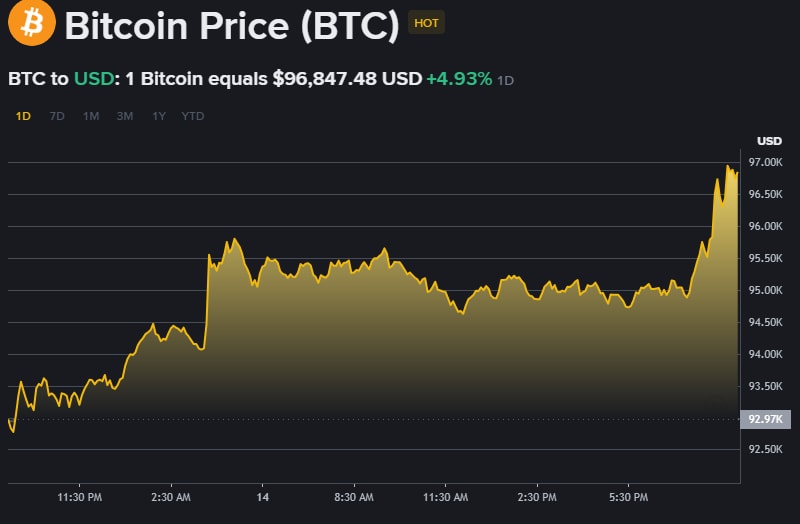
Bitcoin hit $96,946 at 8:45 pm (IST) as markets digested the US Supreme Court’s silence on IEEPA tariffs. With the Court withholding its opinion again, BTC surged more than $1,328 in 45 minutes, rising from $95,617.63 at 8:00 pm (IST), as traders reacted to the extended trade policy limbo.
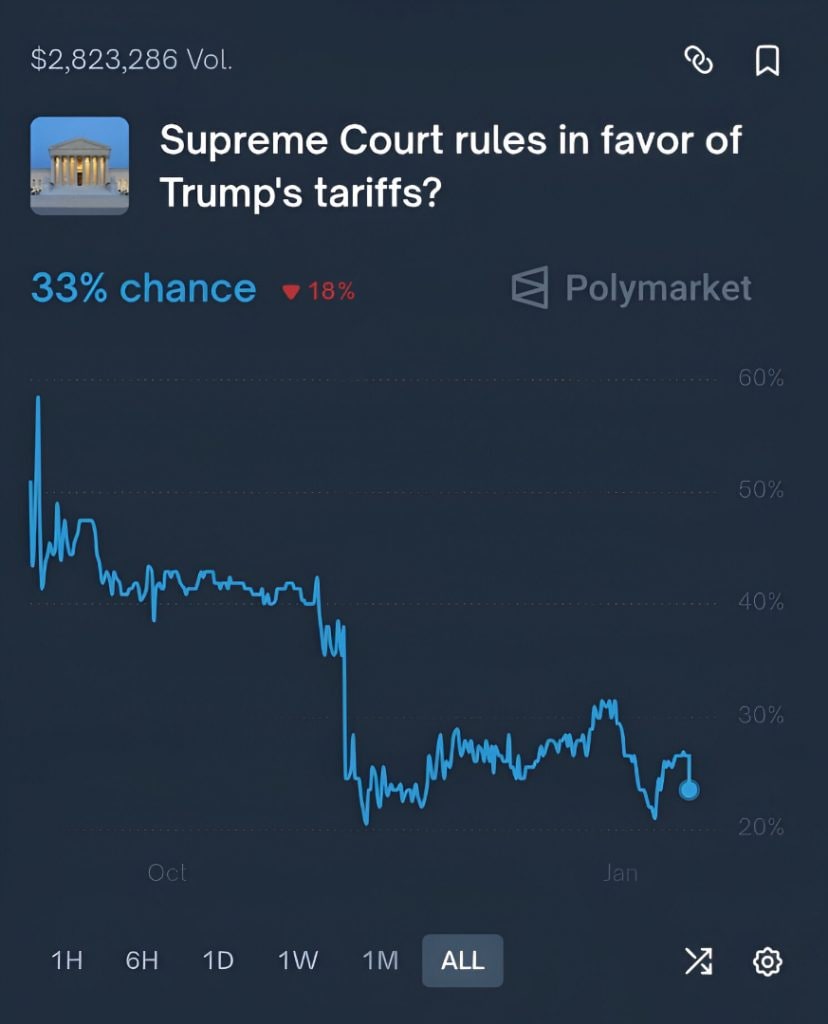
Prediction market Polymarket’s odds of the US Supreme Court ruling in favour of President Donald Trump’s tariffs briefly rose to 33% after the court did not issue a decision today.
The US Supreme Court has not set a new date for its decision on the IEEPA tariffs case. The court does not announce in advance when it will deliver a ruling in a specific case.
The US Supreme Court did not issue an opinion on the IEEPA tariffs challenge on Wednesday, marking the second expected date without a decision. An opinion had been previously expected on January 9. The delay leaves businesses and countries facing continued uncertainty over the future of Trump’s tariff.
US producer inflation rose more than expected in November, with the Producer Price Index (PPI) climbing 3% year-on-year, the highest since February 2023, data released on January 14 showed. The PPI tracks price changes faced by producers and is closely watched because sustained increases can feed into consumer inflation over time.
(Source: US Bureau of Labor Statistics)
First Published: Jan 14, 2026, 16:25
Subscribe Now