D3E Studio: Redefining how software is built with AI, a visual canvas, and a new
Describe it. AI builds it
Last Updated: Jan 28, 2026, 18:25 IST5 min
For decades, building software has been a labor-intensive process—writing thousands of lines of code, coordinating across frontend, backend, and database teams, and repeating the same work for different platforms. Websites, mobile apps, and enterprise systems often require separate stacks, workflows, and skill sets.
D3E Studio is challenging that model.
An AI-powered software creation platform, D3E Studio enables users to build everything from static websites to complex full-stack applications using simple natural language prompts. At its core, the platform combines three powerful layers: artificial intelligence, a visual canvas, and a new declarative programming language called .d3e. Together, they form a unified system that does not merely generate code—it understands, designs, and constructs entire software systems.
Most AI tools today assist developers with isolated tasks—generating snippets, suggesting refactors, or explaining syntax. D3E Studio takes a fundamentally different approach. When a user types: “Create a CRM with login, customer management, and reporting,” the platform doesn’t just sketch UI screens. It reasons about the full architecture. It designs data models, defines relationships, generates forms, builds reusable components, constructs backend services, wires queries, and implements business logic.
“D3E Studio lets people describe what they want—and the system builds it.”D3E Studio also supports the creation of static websites, currently using React with TypeScript. Marketing pages, landing sites, portfolios, documentation portals, and product showcases can all be generated through prompts. These are not locked-in templates—they are real React + TypeScript codebases that can be deployed on platforms like Vercel, Netlify, or GitHub Pages.
More importantly, these static sites are not dead ends. Because they are built using the same .d3e language and widget system, they can later evolve into full dynamic applications without rewriting everything.
One of D3E Studio’s most distinctive features is its visual canvas. While many platforms offer drag-and-drop UI builders, D3E’s canvas is fundamentally different—it is not a mockup environment. It is a live structural representation of the actual application.
Users can compose screens, rearrange layouts, configure properties, define conditional logic, attach behaviors, and preview changes instantly. Every action on the canvas maps directly to a .d3e definition. There is no separation between “design” and “code.”
This makes D3E Studio uniquely accessible. Non-technical users can visually build systems, while developers can inspect and refine the underlying structure. Both are working on the same real application—not a prototype.
At the foundation of the platform is the .d3e language, a declarative, cross-platform language designed to describe what an application is, rather than how it should be implemented in a specific framework.
Using .d3e, users define:
AI-generated code often struggles with maintainability. D3E Studio solves this by enforcing a disciplined architecture.
In practice, that means:
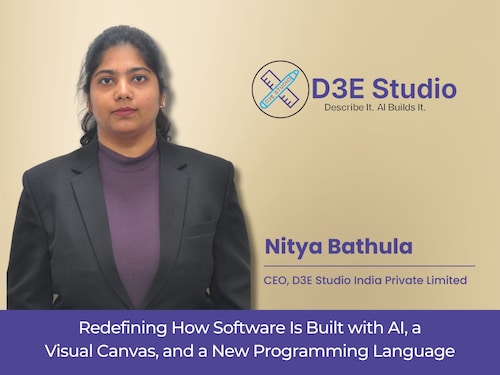
Behind the platform’s technology is Nitya Bathula, CEO of D3E Studio Private Limited (India)—a new-generation technology leader quietly shaping one of the most ambitious AI-driven software platforms in development today.
In an era where AI is redefining how software is created, Nitya represents a rare blend of deep technical grounding and long-term strategic thinking. She leads the India operations of D3E, a US-headquartered company, and oversees the engineering and innovation backbone of the platform.
Nitya holds a Master’s degree in Computer Science from Southern University and A&M College, Baton Rouge, a respected institution in the United States known for its focus on applied research and technical education. Her academic background, combined with hands-on experience in large-scale software systems, gives her a rare blend of technical depth and architectural foresight.
After working with global technology systems, she made a deliberate decision to return to India—not to build services, but to build platforms. Her mission was clear: demonstrate that world-class, IP-driven software products can be built from India and compete globally.
Under Nitya’s leadership, D3E’s India team has grown to over 120 engineers, primarily based in Hyderabad—one of India’s fastest-growing technology hubs.
This team is responsible for:
D3E is not a lightweight tool. It is designed to generate complex systems such as ERP platforms, HR management tools, accounting software, inventory engines, and advanced planning systems.
Building such a platform requires discipline, consistency, and long-term thinking. Nitya has been instrumental in setting engineering standards, establishing structured development processes, mentoring senior engineers, and ensuring that the platform remains scalable and enterprise-ready.
Her leadership emphasizes depth over speed—an approach increasingly rare in an era driven by rapid demos and short-term hype.
Nitya believes India’s future lies not just in services, but in owning global platforms.
“We believe India can build global platforms, not just provide services.”
Through D3E Studio Private Limited, she is helping demonstrate that:
D3E Studio represents a fundamental shift in how software is conceived. Instead of writing code line by line, users describe systems. Instead of wiring components manually, they define intent. Instead of rebuilding for every platform, they generate from a single blueprint.
In simple terms: D3E Studio lets people describe what they want—and builds it.
As AI continues to reshape industries, platforms like D3E Studio point toward a future where software creation is no longer constrained by syntax or frameworks, but driven by clarity, structure, and intelligence. And increasingly, that future is being built from India.
Connect with us at: sales@d3e.studio
The pages slugged ‘Brand Connect’ are equivalent to advertisements and are not written and produced by Forbes India journalists.
First Published: Jan 28, 2026, 18:29
Subscribe Now