Why India is likely to remain the fastest-growing major economy in 2026
Despite external challenges, robust fundamentals, lower GST rates, income tax cuts and interest rate reductions will support middle-class consumption and help keep inflation contained
The global economy has held up despite US tariff hikes and related uncertainty, supported by artificial intelligence (AI)-driven investment, tech-related spending, lower inflation and accommodative financial conditions.
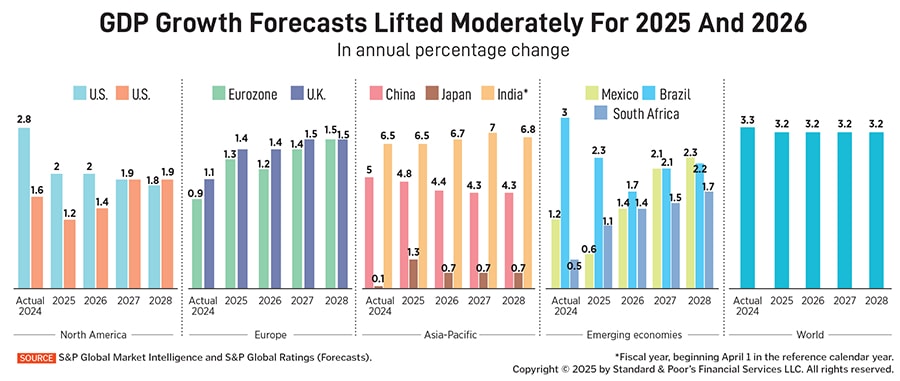
For the all-important US economy, we forecast real GDP growth of 2 percent in 2026—similar to 2025. Real consumer spending growth will hit a cycle low over the next two years, while AI-related infrastructure should sustain investment growth. We expect a 25-basis-point (bp) Fed rate cut in December, followed by 50 bps of easing over the second half of 2026, though timing may shift due to data delays.
Europe should again see modest growth in 2026, with Germany rebounding while others go slow. Disinflation potential appears limited, leaving little scope for additional rate cuts.
China's domestic demand will likely stay subdued, and exports should slow. But we have raised our 2026 growth forecast for China to 4.4 percent due to lower US tariffs. Across the rest of Asia-Pacific, reduced tariff uncertainty, strong tech exports and resilient demand have prompted us to lift our 2026 GDP forecast to 4.2 percent.
Tariffs and Trade
The US trade policy continues to shape Asia-Pacific’s external outlook. Higher effective tariffs on exports to the US are weighing on trade, prompting redirection to other markets and intensifying competition. The October US-China détente reduced global risk, but uncertainty persists, including from plans to curb ‘transshipment’, and the ongoing legal challenges.
India faces the highest US tariffs in Asia, hurting exports and slowing the expansion of export-oriented manufacturing.
A trade agreement with the US would reduce uncertainty and boost confidence, especially for labour-intensive sectors like textiles, gems and jewellery, and seafood, which account for nearly a quarter of India's exports to the US.
India’s Growth Drivers
Despite external challenges, India should remain the fastest-growing major economy in 2026. We expect GDP growth of 7 percent in fiscal years 2026 and 2027, with risks evenly balanced. Within Asia, only Vietnam may achieve comparable growth. Robust domestic demand—both consumption and investment—will drive this performance.
Lower GST rates, income tax cuts and interest rate reductions will support middle-class consumption and help keep inflation contained. Consumption is likely to outpace investment as a growth driver this fiscal year and next.
Investment should remain solid, but the composition may shift. Infrastructure investment may moderate as government moves ahead on fiscal consolidation, while corporate investment—which has lagged in recent years—should gain momentum. Easier monetary and financial conditions, structural reforms like GST rationalisation and labour law overhaul, and healthy corporate balance sheets will support capex expansion. Rising manufacturing capacity utilisation could add further momentum.
The current US tariff situation limits the benefits India could reap from global supply chain shifts. But relief on the US tariff front would unlock investment in manufacturing by both foreign and domestic firms.
Sustained medium-term growth momentum will require ongoing reform efforts to adapt to the evolving world economic landscape. Efforts to improve infrastructure, with an emphasis on urban infrastructure, can increase productivity. India’s female labour force participation rate remains low, and reforms supporting women’s labour conditions could be key. Quick technology adoption—to remain at the forefront of the global technology frontier—will also be important.
Inflation and Monetary Policy
Like other Asian economies, India’s short-term inflation outlook seems benign. We’ve reduced our CPI forecast to 2.5 percent for the current fiscal year because of low food and oil prices and GST rationalisation. Excess supply in China could exert downward pressure on import prices.
However, food inflation remains vulnerable to climate change. The rise of extreme weather events—such as excess rains affecting the autumn crop—may cause intermittent spikes. Low base effects mean food prices may rise in 2026-27.
Given these dynamics, the Reserve Bank of India has limited scope for further easing. The policy rate is already broadly at the “neutral” level, and the rupee weakness amid capital outflows and tariff uncertainty argues against significant further rate cuts. We expect one more 25 bps rate cut this cycle. With US rates expected to fall more, the increasing differential should provide some buffer against international shocks.
Bottom Line
External headwinds—from tariffs to trade uncertainty—will persist. But India’s strong domestic fundamentals, structural reforms and resilient consumption position it to remain the world’s fastest-growing major economy in 2026.