How to make money honestly, Jessica Alba style
Actress Jessica Alba has quickly built a personal $200 million fortune, and she's done it the hard way, in a field that has nothing to do with showbiz
Last Updated: Jun 18, 2015, 06:30 IST10 min

It’s Kombucha Thursday at the Santa Monica headquarters of The Honest Company, which means that groups of young, stylish workers gather at communal tables in a converted toy factory to slurp fashionable fermented tea. Jessica Alba, Hollywood star and company co-founder, sits in the adjacent room. She’ll join her troops, but for now she’s transfixed by a box of tampons that looks more like it holds an expensive candle than kotex. “Dope!” she declares, approvingly.
“We’re using all-organic cotton and plant-based polymer and a bio-plastic applicator,” says the 34-year-old actress earnestly, contrasting that with the plastic content of drugstore tampons and their effect on hormones. Honest’s new feminine care line launches in July.
Alba can go similarly deep on almost all of The Honest Company’s 120 products, whether the ingredients in a new organic beeswax sunscreen or the clever insulation pocket hidden inside a chic $170 vegan-leather diaper bag. Yes, she has a pretty face—it seems as if every men’s magazine has named her the most beautiful woman in the world at some point—but it’s the details from which great fortunes stem.
Details and hard work. Alba laughs about how she once worked an 86-hour week as the star of James Cameron’s sci-fi TV series, Dark Angel—it launched her career. Now, she says, she spends 86 hours at a vintage teal blue desk, overseeing marketing and brand development for a company that feeds a growing demand for safe, nontoxic products, particularly among young helicopter parents who treat children—and what goes near or inside them—like porcelain.
Safety sells. The Honest Company has experienced an absurd level of growth. In 2012, its first year selling products, it hit $10 million in revenue. By last year it was $150 million, and industry insiders are predicting over $250 million this year. The company is focussed on growth over profits, boasting a current valuation to match: $1 billion.
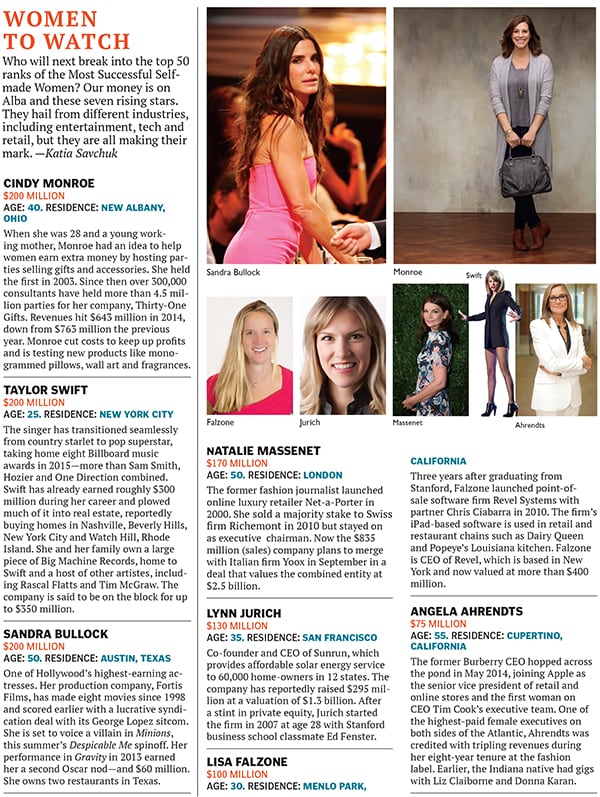
That figure means Alba, who owns between 15 percent and 20 percent of the company, according to a source with knowledge of her investment, is sitting on a fortune of $200 million. She’s on her way to earning a spot on Forbes’s new ranking of America’s Richest Self-Made Women, just $50 million shy of Beyoncé and Judge Judy, who are tied at number 49. The only other two celebrities on the inaugural list are Oprah and Madonna. The difference is that foursome made their money in their core field, media and music. Alba has done it in a completely unrelated industry. But ask Alba and she’ll tell you she and Honest are just getting started. “If we really want to make a difference in the world and people’s health, it’s billions and billions of dollars, not just one,” she says.
Like most great ideas, The Honest Company was inspired by a need that wasn’t being filled. In 2008 Alba was newly engaged to internet entrepreneur Cash Warren and pregnant with their first child. At a baby shower, she remembers her mother advising her to use baby detergent to prewash the piles of onesies she’d received as gifts. She used a mainstream brand and immediately broke out into ugly red welts, harkening back to a childhood spent in and out of emergency rooms and doctors’ offices.
“She was the most sensitive child,” remembers her mother, Cathy Alba, who wasn’t referring to her daugh- ter’s emotional well-being. Raised on Air Force bases in such places as Biloxi, Mississippi, and Del Rio, Texas, Jessica’s bad allergies and chronic asthma made her predisposed to pneumonia, which she contracted about twice a year, often leading to two-week hospital stints.
Now covered in hives again—and wary of having her baby relive her own experience—Alba spent late nights on Google and Wikipedia researching the contents not just of the offending detergent but also of everything in her bathroom cabinet and under her kitchen sink. “I was like, ‘How can this be safe for babies if I’m having this type of reaction?’” she says. What she found terrified her: Petrochemicals, formaldehydes and flame retardants in everyday household products from floor cleaners to mattresses. Some were listed on the ingredients label plain as day, with others disguised under the catchall of “fragrance”, which is entirely legal.
Armed with printouts and fear for the health of her unborn child, Alba first tried to shop around the problem but grew irritated trying to find natural and eco-friendly products that weren’t either extortionate or seemingly designed for yurt-dwelling vegan yogis. Or both. “I felt like my needs weren’t being met as a modern person,” she says. “I want beautiful design like everybody else. But it shouldn’t be premium-priced, and it should, of course, be safe.”
She tried making her own cleaning products out of baking soda, vinegar and essential oils but wound up with something closer to salad dressing. So when she came across Christopher Gavigan, who for seven years led a non-profit called Healthy Child Healthy World, she, like most new mothers, asked him what to buy.
“They don’t want to be that investigatory weekend toxicologist,” says Gavigan. “They just want someone to hold their hand.” He explained that several companies with ‘green’ credentials like Vermont-based Seventh Generation were doing good work across some product categories, but there was no one umbrella brand positioning itself as the go-to for all things eco-friendly, safe and nontoxic.
A lightbulb went off for both of them. Pretty soon Alba and Gavigan were cooking up a business plan and buying up web domain names with the word “honest” in them. Through her husband, she met web entrepreneur Brian Lee, a trained attorney who had hit it big with LegalZoom.com, an online legal-documentation service he co-founded with Robert Shapiro of OJ Simpson infamy. “I made some introductions for her and said good luck,” says Lee, who looked at Alba’s 50-page PowerPoint in 2009 but didn’t bite. He says now he was simply tied up launching subscription shoe site ShoeDazzle.com with then partner Kim Kardashian.
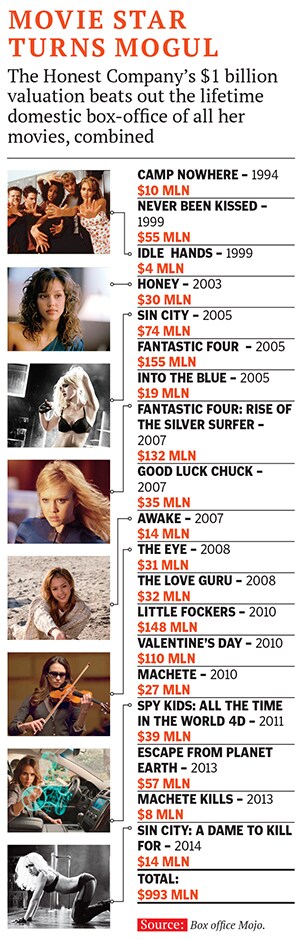
Meanwhile, Alba was busy with her Hollywood career, starring in the likes of Valentine’s Day, Little Fockers and Machete, all of which premiered in 2010.
Alba kept Gavigan on her payroll as a consultant. By 2011 she had turned herself into an expert on consumer products and traveled to Washington, DC, to lobby for updated legislation. She was—and is—particularly focussed on reforming the 1976 Toxic Substances Control Act, which has allowed more than 80,000 chemicals to remain in household products untested. Only five are regulated by the Environmental Protection Agency only 11 are banned from consumer goods. (In Europe that figure is more than 1,300.) “Enough people have to get sick or die from a certain ingredient or chemical before it’s pulled from the marketplace,” says Alba.
For Alba’s husband, Cash Warren, it was a lesson in climbing a steep learning curve. “I didn’t know much about all the chemicals that were in our consumer products, so she educated me on this epidemic,” he says. “It felt massive, so I was a little reserved at first. She jumped into it headfirst.”
She went back to Brian Lee in 2011 armed with data on the rise of childhood diseases and a much more concise 10-page pitch deck. Lee’s mind had changed—not coincidentally, he had recently become horrified when his young son was banned from bringing that classic, all-American lunch the PB&J sandwich to nursery school. Too many kids had severe nut allergies. “Autism, Tourette’s, chronic allergies and asthmas and celiac disease—all of this stuff is on the rise,” Lee says. “I almost had this moment of awakening. Why aren’t we doing something about this?”
Lee got on board with Alba and Gavigan that year, bringing with him a fourth co-founder in Sean Kane, who’d spent a decade selling discount products at Pricegrabber.com. Lee and Alba seeded their new startup to the tune of about $6 million, with another investor, according to a source close to the deal. (The company would not comment on initial investments or its founders’ current personal stakes.) The group called their new firm The Honest Company, as a nod to its values and transparent ingredients.
One wall of the honest Company’s Los Angeles office showroom best represents its roots. On it you’ll find rows and rows of diapers, mounted, matted and framed. Each has a whimsical design on the butt. There’s one with a purple-and-green leopard print there are juicy pink strawberries and a stars-and-stripes print perfect for baby’s first Fourth of July.
These are the diapers that gave The Honest Company its start and indeed still account for a large proportion of sales: About 75 percent of revenues still comes from online commerce, and the majority of that is from the company’s $79.95 monthly bundles of diapers and wipes.
During Alba’s days scouring supermarkets for safe baby detergent, she often wondered why no one in the retail or fashion world had yet come up with seasonal designs for diapers. “I kind of want them to be cute,” she says. “And the natural diapers: Why do they have to look like your baby’s wearing a brown bag?”
After having her first daughter, Honor, in 2008 (in 2012 she had another daughter, Haven), Alba also found herself routinely running out of diapers in the middle of the night. She was toying with the idea of a subscription service for nontoxic household essentials—cleaning products, maybe diapers, too. But this was long before monthly cosmetics-sampling startup Birchbox launched, and that business model didn’t really exist.Creating safe, chemical-free, nontoxic consumer goods from scratch without the infrastructure of, say, a Procter & Gamble or a Kimberly-Clark was a prospect that would cost way more than even the $6 million seed fund. So they went looking to get venture capital into the diaper business. “That’s the only thing we pitched,” says Lee. “It was very strategic as we knew that was the way into your home.”
Lee was a known quantity among the venture capital firms of Palo Alto. Even so, The Honest Company took a gamble approaching backers without having made even a dollar of revenue. “They hadn’t shipped yet when we invested, so it was a leap of faith we don’t normally take in ecommerce businesses,” says Neil Sequeira, a managing director at General Catalyst Partners.
He was a big believer in online- only models, having backed pioneering eyeglasses etailer Warby Parker. He also liked the subscription aspect of the business: It took much of the pain—and expense—out of acquiring new customers. “Assuming they like it, the big Super Bowl ads and stuff become less important,” he says. Early on Honest relied on Facebook for efficient advertising instead of traditional campaigns. General Catalyst joined Lightspeed Venture Partners and Institutional Venture Partners in a 2012 Series A that raised $27 million.
That turned out to be just the start. As the diaper business proved its efficacy, Alba and her team—Lee serves as the CEO—reverted to the original concept: A single brand that carried its credibility across all products in the nontoxic universe. Raising a total of $127 million through August 2014, The Honest Company has been able to create more products in different categories—dish soap, kitchen cleaner, detergent, nipple balm, multi-vitamins and even nursery furniture.
Lee, Alba and their team intended for The Honest Company to remain online, where its revenues grew steadily thanks in part to the actress “trying to yell from the roof-tops,” as she describes her marketing efforts. (She has over 5 million Instagram followers on her own account.)
But almost as soon as they launched, high-end mommy-and-baby boutiques with cutesy names (The Pump Station in west Los Angeles and The Upper Breast Side in Manhattan) cottoned on to The Honest Company, asking whether Lee and Alba had considered selling the brand in brick-and-mortar stores. Stock in these mom-and-pop shops sold out so quickly that when Costco came calling in 2013 wanting to sell baby shampoo in family-size packs, the Honest team relented. Since then Whole Foods, Nordstrom, Buy Buy Baby, Destination Maternity and even discount behemoth Target have started selling The Honest Company’s wares. Two things stand out on their short-term agenda. First, international expansion. Honest products will debut in South Korea later this year and in China possibly in 2016. And then, most likely next year, a public offering, according to people familiar with the company. Such a move provides a war chest, though that doesn’t seem to be an issue at present. “The company’s outperforming,” says General Catalyst’s Neil Sequeira. “They have pretty much unlimited access to capital and a very strong balance sheet.” Liquidity, then, would seem to be the key driver.
With a big payday in the offing, Alba remains an active presence, much to the delight of her venture capital backers, who had built-in celebrity endorsement from a co-founder. “I think they realised they got a lot of bang for their buck,” Lee says. Alba still makes the occasional film, but she makes quick work of it. She shot her scenes for the upcoming movie adaptation of hit series Entourage in three hours. In 2016 she’ll appear in a sequel to crime-caper mainstay Jason Statham’s The Mechanic. “It took 10 days in November and 10 days in January, and I got to be in a fun action movie,” she smiles.
First Published: Jun 18, 2015, 06:30
Subscribe Now