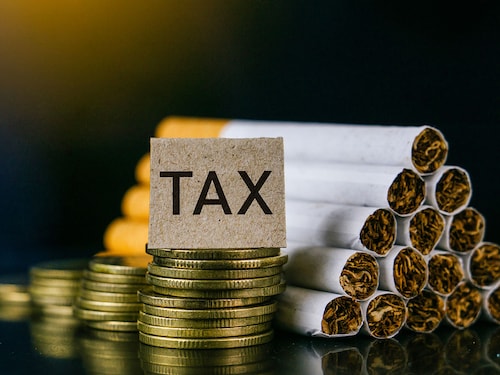
How Cigarette Prices are Likely to be Affected
The revised excise structure disproportionately affects longer and premium cigarette formats.
Short non-filter cigarettes of up to 65 mm will face an additional duty of around Rs 2 per stick, while short filter cigarettes will see a slightly higher burden. Medium-length cigarettes will attract an added duty of roughly Rs 3.6 to Rs 4 per stick, while longer cigarettes in the 70–75 mm category will face duties of about Rs 5.4 per stick.
A higher slab of Rs 8,500 per 1,000 sticks applies mainly to non-standard formats, with most mass-market brands falling outside this category. Companies are expected to respond through price hikes, though the extent to which higher prices can be passed on without affecting volumes remains uncertain.
Pan Masala and Cess Changes
Alongside cigarettes, the government has also notified a capacity-based excise levy on pan masala, chewing tobacco and gutkha manufacturing units under the Health and National Security Cess Act, effective February 1.
While the structure of taxation has changed, the overall tax burden on pan masala products will remain at 88 per cent, including GST. The new regime replaces the earlier framework that combined 28 per cent GST with a compensation cess.
The Bidi Exemption
In September, the GST Council reduced the tax rate on bidis to 18 percent from 28 per cent, while also cutting GST on bidi wrapper leaves, or tendu leaves, to 5 percent from 18 percent. The Council also proposed simplifying the GST structure into two principal slabs of 5 percent and 18 percent, while carving out a special 40 per cent slab for select items such as cigarettes and tobacco.
The bidi tax cut triggered political backlash, with the Kerala unit of the Congress party criticising the decision on social media. In the post, which was later deleted, the party said that “bidis cannot be considered a sin anymore”, linking the tax cut to Bihar, a key bidi-producing and consuming state. The state was also slated for Assembly elections at the time. Leaders of the Bharatiya Janata Party and the Janata Dal (United) responded by accusing the Congress party of insulting Bihar and politicising tax policy ahead of state elections. Congress leaders later responded by stating that they were questioning the policy inconsistency of lowering taxes on bidis while increasing tax on all other tobacco products.
Bidis are significantly cheaper than cigarettes and are consumed largely by lower-income users, particularly in eastern and central India. The bidi industry is also labour-intensive, employing millions of worker—many of them women—in states such as Bihar, West Bengal, Madhya Pradesh and Odisha. Governments have historically taxed bidis at lower rates than cigarettes, citing employment concerns and the informal nature of the sector. At the same time, public health experts have consistently pointed out that bidis are no less harmful than cigarettes.
ITC, Godfrey Phillips Stock Drop and Brokerage Views
Shares of ITC, Godfrey Phillips India and VST Industries fell sharply on the NSE and BSE over January 2 and January 3, as investors assessed the impact of higher cigarette taxes on pricing, volumes and earnings. ITC declined by about 8-10 percent over the two sessions, while Godfrey Phillips India fell nearly 15-18 percent. VST Industries slipped around 3-4 percent over the same period.
Brokerages described the move as far more aggressive than expected. Motilal Oswal downgraded ITC to Neutral from Buy and cut its target price to Rs 400 from Rs 515, saying the “unprecedented tax hike forces a valuation multiple reset”. “The favourable phase for the legal cigarette industry has ended,” Motilal Oswal said, adding that volumes are likely to revert to historical levels under a high-tax regime.
Emkay Global downgraded ITC to Reduce from Add and cut its target to Rs 350 from Rs 475, calling the move a “fiscal bombshell”. “The regulatory stance has clearly shifted towards curbing consumption,” Emkay said, adding that it expects staggered price hikes of around 32 per cent, which could further pressure demand.
B&K Securities maintained a Buy rating on ITC, though it cut its target price to Rs 504 from Rs 567. It said cigarette volumes are now “clouded by a 20–65 percent tax hike, well above expectations of 10–15 percent”. B&K said it is building in a 5 per cent volume decline in FY27, offset by an average 25 per cent price increase.
Macquarie retained its Outperform rating with a target price of Rs 500. It noted that excise duty on filter cigarettes has been raised to Rs 2,100–Rs 8,500 per 1,000 sticks, depending on length, and said cigarettes under 65 mm may require 10–35 percent price hikes to sustain earnings before interest and taxes (EBIT) per stick. Macquarie added that moderating leaf tobacco costs could partially offset near-term pressure, though it flagged taxation as a clear growth risk.
On January 2, Godfrey Phillips India ended the session 1.77 percent lower on the BSE. The stock has fallen 20.21 percent over the past five trading sessions between December 29 and January 2. ITC was also under pressure, closing 3.78 percent lower on January 2. Over the past week, the stock has declined 13.15 percent on the BSE.
VST Industries saw relatively smaller losses, ending the day down 1.10 percent, with the stock down 1.86 percent over the last five sessions.