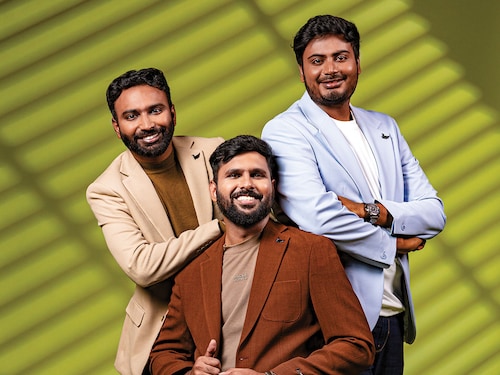
Modulus Housing: Building transition shelters for the needy
Co-founded by Shreeram Ravichandran, Gobinath P and Jawahar Rajasekar, it is a one-stop shop for constructing pre-fabricated, low-rise buildings in quick time, even in a few days
(From left) Gobinath P, Jawahar Rajasekar and Shreeram Ravichandran.
Photo by Madhu Kapparath
Advertisement
Shreeram Ravichandran (29) Co-founder and CEO, Modulus Housing Gobinath P (29) Co-founder and COO, Modulus Housing Jawahar Rajasekar (27) Head of operations and founding team member, Modulus Housing
In 2015, Shreeram Ravichandran, Gobinath P and Jawahar Rajasekar were students at IIT-Madras when the city was hit with catastrophic floods that affected over 40 lakh people. The trio was out distributing relief material when they were confronted with an existential question. “We wondered what happened when people lost their homes in natural disasters,” says Shreeram. They did a quick study of the aftermath of the 2004 Indian Ocean tsunami, the deadliest in recorded history, and saw that it took at least five to seven years for the government to allocate funds and rebuild homes for the displaced. “That’s when we realised the need for transition shelters.”
Set up in 2018, the year they graduated, Modulus Housing is a one-stop shop for constructing pre-fabricated, low-rise buildings in quick time—even in a few days, say the founders. The building blocks are prepared at their factories—the foundation from proprietary concrete and the super structure (walls, roofs etc) from alternatives like PUF panels or the concrete again—and assembled on site. “Just like Lego,” says Jawahar. “If it’s a smaller cabin, it will come as a whole. If it’s a bigger structure, we will put together multiple smaller cabins in a pattern. Imagine how a telescope folds and unfolds. Our basic concept is similar.”
The first hitch Modulus faced was to build a sustainable venture out of disaster relief. “You can’t predict a disaster,” says Shreeram. That’s when they began to extrapolate to other areas—in building primary health centres, agri shelters, anganwadis etc. During the Covid-19 pandemic, Modulus put together 600-odd portable, modular hospital units that could be assembled by four people in 2 hours.
“When you turn construction into a product, you can deliver it to areas that are underserved,” says Shreeram. “You can take high-quality, centrally-manufactured buildings to the remotest of places, where supply chains are completely broken, and deploy them on site in a few hours.”
From the far-flung Northeast to metros like Delhi, Modulus has now erected more than 1,600 front-loaded homes in 22 states and countries like Malawi in Africa. Of these, with over 350 buildings, its footprint is most prominent in Meghalaya. “Gobi has a fancy way of putting it—if you stand anywhere in Meghalaya, you’ll find a house built by us within 4 km,” laughs Shreeram. The company has executed projects for the likes of the Asian Development Bank, the World Bank and the Gates Foundation, aside from state and central governments.
“In most civil engineering work, there’s little planning, leading to a lot of wastage. That’s where Modulus scores. They are able to economise by judiciously doing modifications that are planned as per the design,” says S Christopher, former DRDO chairman and currently a professor with IIT-Madras, who has mentored the company for three years. “Modulus’s work has been thoroughly analysed by experts at IIT-Madras for longevity, and their processes have been found to be robust.”
Modulus, which reported a revenue of ₹54 crore in FY24, operates with a cloud kitchen-style model where it has 10 manufacturing partners, and close to 300 installation partners on site, each of whom carry a labour force of anywhere between 10 and 40 people. The trio founded the company with ₹25 lakh, their nest egg for an MBA, but have now raised their first institutional funding of ₹70 crore in a round led by Kalaari Capital, Hero and Samarthya. With the corpus, they plan to tap into global markets, build a for-profit vertical through partnerships with corporates, while continuing to deepen the reach of their social impact initiatives.