Economic Survey: Pharma scale up collides with obesity, NCD boom
India pivots to high-value biosimilars and AI-led med-tech, but faces a silent threat as non-communicable diseases and obesity rise. Can innovation outpace a growing lifestyle disease burden?
By volume, India ranks third globally and supplies ~20 percent of the world’s generics to 191 markets, over half of which are highly regulated jurisdictions like the US and Europe. Photo by Shutterstock
Advertisement
India’s drug and devices engine is shifting from scale to sophistication just as public health delivery deepens—setting up a tighter loop between what the country makes and what its health system now consumes.
By volume, India ranks third globally and supplies ~20 percent of the world’s generics to 191 markets, over half of which are highly regulated jurisdictions like the US and Europe. FY25 pharma turnover touched Rs4.72 lakh crore, with exports growing at a 7 percent CAGR over FY15-FY25.
The next leg is value: A pivot toward complex generics, biosimilars and innovation. Even though India sits 11th by pharma export value (3 percent share), there is a lot of headroom for growth. On the devices side, exports reached $4.1 billion in FY25 (up from $2.5 billion in FY21), with domestic capabilities now spanning MRI/CT scanners, linear accelerators, cardiac stents and ventilators—a clear turn into higher tech manufacturing.
On input resilience, API localisation is gathering pace. The PLI for bulk drugs has mobilised Rs4,763 crore in investment and created 55,000 MT/year capacity across 26 critical molecules, including fermentation based KSMs like Penicillin G Potassium, a precursor to widely used semi synthetic antibiotics.
Three bulk drug parks—Gujarat, Himachal Pradesh and Andhra Pradesh—are under development with Rs3,000 crore in support. The PLI (pharma) delivered Rs2.63 lakh crore in sales in its first three years, including Rs1.69 lakh crore in exports, with domestic value addition at 83.74 percent (as of March 2025).
Devices are seeing a similar trend: The PLI for medical devices has triggered Rs1,093.69 crore of actual investment with 57 high end devices already in production; medical device parks in Uttar Pradesh, Tamil Nadu and Madhya Pradesh have final approvals of Rs100 crore each, and land allotted to 184 manufacturers.
Public Health Investments
The Economic Survey 2025-26 sounds a loud alarm on India’s "demographic dividend", warning that rising obesity rates—now affecting 24 percent of women and 23 percent of men—threaten to undermine the nation's productivity. This health crisis is largely attributed to the explosive 150 percent growth in ultra-processed food (UPF) sales between 2009 and 2023. To counter this, the Survey proposes aggressive fiscal intervention, suggesting a "health tax" that would place these high sugar, salt and fat products under the highest GST slab plus an additional surcharge to curb consumption and safeguard public health.
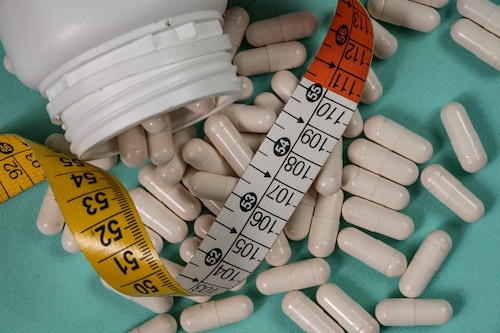
Interestingly, this policy push coincides with a massive commercial pivot in the pharmaceutical sector: The rise of weight-loss drugs (GLP-1s). With India's anti-obesity drug market projected to grow at a 25 percent CAGR through 2030 and blockbuster generics like semaglutide entering the fray this year, the Survey’s warnings effectively highlight the massive, untapped demand for medical weight management in a market previously dominated by processed convenience.
Additionally, Ayushman Arogya Mandirs now exceed 1.82 lakh facilities, logging 506.5 crore footfalls and 42.66 crore teleconsultations, while Ayushman Bharat Pradhan Mantri Jan Aarogya Yojana has issued 42.78 crore cards and enabled 10.98 crore hospital admissions, as per the Economic Survey.
In parallel, the Health Infrastructure Mission is adding public health labs, block units and critical care blocks—each a direct consumer of drugs, diagnostics and devices. At the same time, India’s disease burden is shifting: Non communicable diseases now account for over 57 percent of deaths, led by cardiovascular disease, pushing sustained demand for chronic therapies and monitoring.