Indian carmakers finding a second engine of growth abroad: Economic Survey
Survey highlights robust demand recovery after the pandemic and the rising global acceptance of India-made vehicles
Last Updated: Jan 29, 2026, 16:23 IST2 min
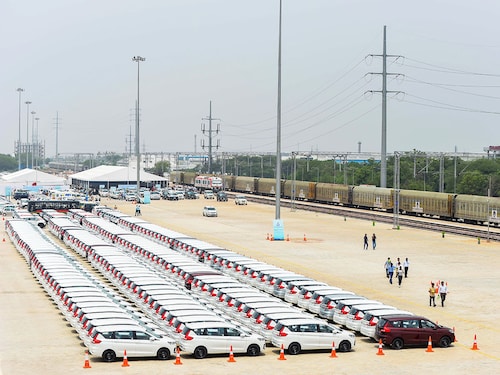
The automotive industry is turning a decade of sustained production growth into export momentum, a shift the Economic Survey frames as growing international confidence in vehicles made in the country. “The (auto) industry has recorded nearly 33 percent growth in production over the last decade,” according to the Economic Survey 2025-26, which attributed the expansion to a “robust demand-side recovery” after the pandemic.
That additional output is finding an outlet in exports. Vehicle shipments abroad posted "double-digit growth in the first half of FY26", which the Survey said reflected rising global acceptance of India-made vehicles.
Industry data underscores the trend. Passenger vehicle exports rose 16 percent to 670,930 units between April and December, according to the Society of Indian Automobile Manufacturers. Two-wheeler exports climbed 24.2 percent to 3.8 million units, while commercial vehicle exports jumped nearly 59 percent to just over 25,000 units.
Carmakers are leaning into that shift. Maruti Suzuki, the country’s largest car manufacturer, expects to export about 400,000 vehicles this fiscal year, having already shipped roughly half that volume in the first six months. The company is targeting annual exports of 750,000 to 800,000 vehicles by FY31. Korean automaker Hyundai Motor, which lost the number 2 carmaker tag last calendar year, is also positioning India as a global export base, with a goal of having exports make up 30 percent of its production by 2030.
The export push builds on India’s scale at home. The country is the world’s largest market for two-wheelers and three-wheelers, and the third-largest globally for passenger vehicles and commercial vehicles. That scale has supported a broad manufacturing and components ecosystem, and also raised the stakes for economic policy.
The automotive sector, the Survey said, is a significant driver of economic growth, providing “direct and indirect employment to over 30 million people” and contributing “nearly 15 percent of the country’s GST collections”.
Any sustained shift toward export-led growth feeds directly into jobs, supplier networks and tax revenues.
Government policy has increasingly focussed on shaping the industry’s next phase, particularly around electric mobility. The production-linked incentive scheme for automobiles and auto components, approved in 2021 with an outlay of Rs25,938 crore, has “attracted a cumulative investment of Rs35,657 crore till September 2025” and resulted in the creation of 48,974 jobs, the Survey said. A parallel incentive programme for advanced chemistry cell battery storage, with Rs18,100 crore earmarked, is pushing battery manufacturing onshore, with “40 GWh capacity already awarded”.
The PM E-Drive scheme, launched in September 2024 with an outlay of Rs10,900 crore, provides demand incentives for e-2W and e-3W, and extends support to newer categories such as electric trucks and ambulances, while also funding charging infrastructure. Another initiative, the PM e-Bus Sewa payment security mechanism, is designed to “support deployment of over 38,000 electric buses” by reducing payment risk for operators.
The government is also calibrating how global automakers participate in India’s EV transition. A scheme notified in March 2024 allows limited imports of high-value electric passenger cars at reduced customs duties, provided companies commit at least Rs4,150 crore in local investment and meet phased domestic value-addition targets. The aim, the Survey said, is to “promote India as a manufacturing destination for e-cars".
First Published: Jan 29, 2026, 16:27
Subscribe Now