Countries rarely get second chances in technology. India has one now and should not miss it.
That sentiment framed a wide-ranging discussion at a pre-Budget roundtable hosted by Forbes India, where Deloitte partners Saloni Roy, Sumeet Hemkar, Anujesh Dwivedi, S Anjani Kumar and Antony Prashanth debated what the upcoming Union Budget must address as India navigates global uncertainty and rapid technological change. Across sectors, there was broad agreement on one point: India must become a nation of builders, not just consumers.
In artificial intelligence (AI), India is at a moment reminiscent of the late 1990s. Then, the country became a global hub for IT services but failed to create globally scaled technology products. Kumar argued that AI offers a rare opportunity to correct that imbalance.
“We had a similar situation in the late 1990s, when India was able to capitalise on the IT services and the BPO boom. And we became a fairly strong nation as far as IT services was concerned; it’s a $200 billion plus industry today. But one bus that we missed was products,” said Kumar.
“Today, we are in a similar situation, where there are AI services and products. Think Alexa, ChatGPT or Gemini. They are all examples of AI products where you’re charging customers, corporates, individuals, on a subscription basis for a product. I think we are doing well as far as AI services is concerned, but we have the opportunity to also become a world leader in AI products, and that's the bus we should not miss, like we did in the late 90s.”
Kumar described AI as an ecosystem split into two parts. “Inside the walls”, where the core elements sit: Semiconductors, GPUs, cloud infrastructure, large language models and AI applications. “Outside the walls” are the enabling requirements such as power, water, transmission infrastructure and cooling. India’s policy focus so far, he noted, has been largely on the first category, including the Rs10,000-crore IndiaAI Mission that targets compute, skills, datasets, startups and applications.
For a country of India’s size, Kumar said, the current scale of compute infrastructure remains inadequate. More critically, AI investments will be constrained unless issues around electricity availability, renewable power, water usage and grid connectivity are addressed in parallel. Data centres, which underpin AI, are among the most energy- and resource-intensive assets, making policy support for efficient power and water usage essential.![]()
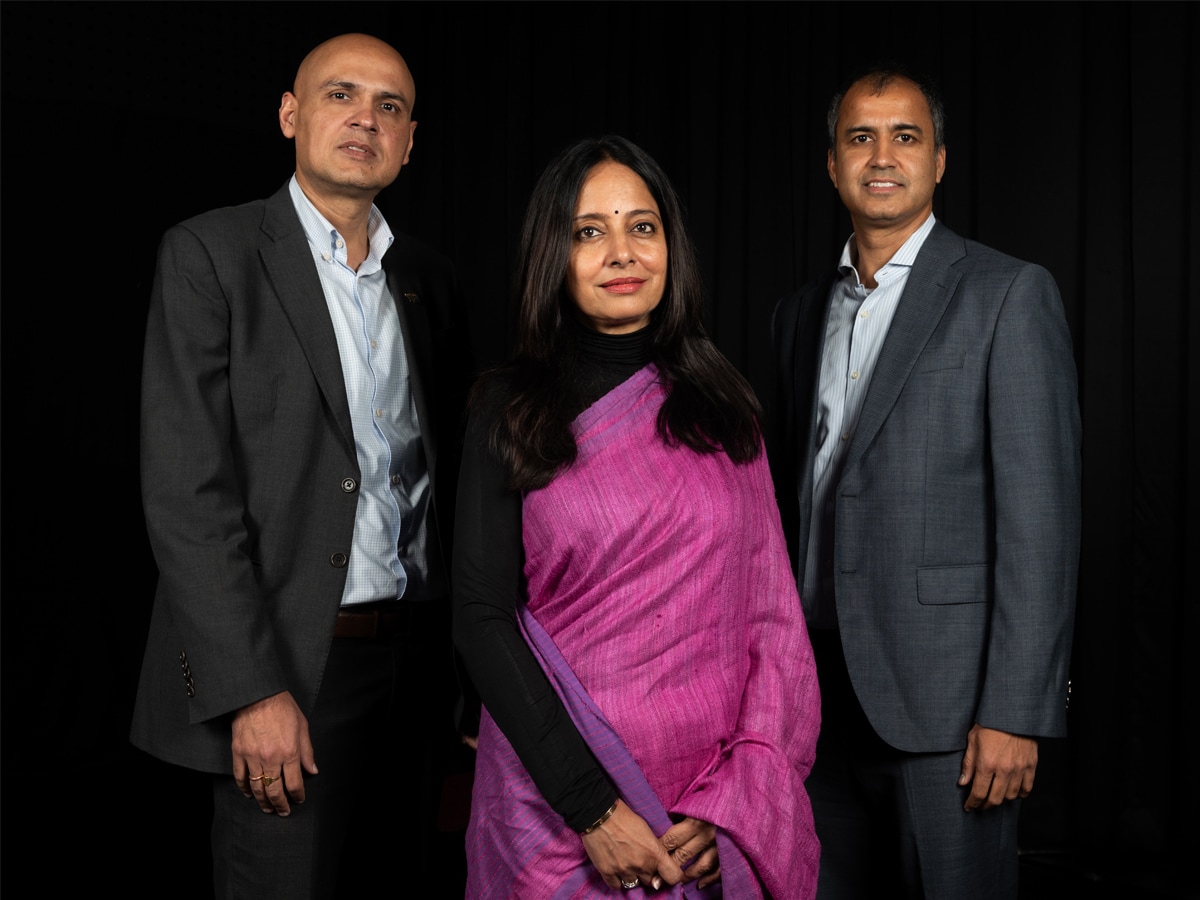
(L to R) Anujesh Dwivedi, Saloni Roy and Sumeet Hemkar, partners at Deloitte India. Photo by Amit Verma
Kumar also argued that India should prioritise building smaller, domain-specific language models tailored to sectors such as agriculture, healthcare, education and governance, rather than competing directly with trillion-parameter global models. Such an approach would reduce costs, lower compute requirements and better align with domestic needs. AI services, he said, will grow regardless, but long-term value will accrue to countries that create AI products.
The discussion on AI set the tone for a broader debate on the economy ahead of the Union Budget. Roy said recent reforms show the government is increasingly responsive to industry concerns. The overhaul of the GST regime, including rate rationalisation and fewer slabs, has supported consumption without hurting collections, she said, though inverted duty structures continue to raise costs for manufacturers.
Roy added that customs duties represent the next major reform opportunity. With tariff uncertainty weighing on exports—particularly to the US—simplification and predictability in customs policy could provide relief without straining fiscal space.
Panellists stressed that policy certainty, rather than incentives alone, is now the key requirement.
Frequent amendments, prolonged tax disputes and regulatory ambiguity, they argued, have discouraged long-term investment and contributed to talent and entrepreneurial outflows.
“The government has taken a big step in introducing the Income Tax law of 2025 which replaces the 1961 law. And the objective has been very clear: To simplify the law,” said Hemkar.
“The government wants to remove the redundancies from the law. So references should be simpler and, hopefully, interpretation will be simpler, although in some senses, the goalpost changes because the language changes under the new legislation. It’s a bold but a good step in trying to make the environment simpler for an average taxpayer.”
Energy and manufacturing were also central to the discussion. Deloitte’s Dwivedi highlighted India’s rapid expansion in renewable energy, with nearly 50 gigawatts of solar capacity added in calendar year 2025. While renewable generation is rising, constraints remain in transmission infrastructure and high-voltage equipment manufacturing. Electric vehicles and battery storage are advancing faster, aided by aligned policies on adoption and manufacturing, though access to critical minerals remains a strategic challenge.
“More needs to be done on accelerating domestic discovery of deposits and also harnessing those, then refining those, or extracting the materials which can be used locally… recycling of critical minerals is also likely to see some focus (in Budget).”
In pharmaceuticals, Deloitte’s Anthony Prashanth said India’s growth ambitions—from a $60 billion industry today to $130 billion by 2030—will require a shift from volume-led generics to higher-value biosimilars and complex formulations. Increased R&D spending, faster regulatory approvals and greater use of AI to improve manufacturing efficiency will be crucial. “US tariff uncertainty is unlikely to significantly disrupt India’s pharma exports, given the scale and embedded nature of existing supply chains.”
One theme central to the discussion was how innovation and product creation lag behind. Whether in AI, semiconductors, pharmaceuticals or clean energy, panellists said the Budget must focus on building long-term capabilities rather than short-term gains.
As the roundtable concluded, there was consensus that the upcoming Budget may not be remembered for large tax cuts or headline-grabbing giveaways. Instead, its significance will lie in whether it signals a commitment to predictable policy, sustained investment in new-age infrastructure and a shift from consumption and services towards innovation and value creation.
Read Forbes India's complete Budget 2026-27 coverage here