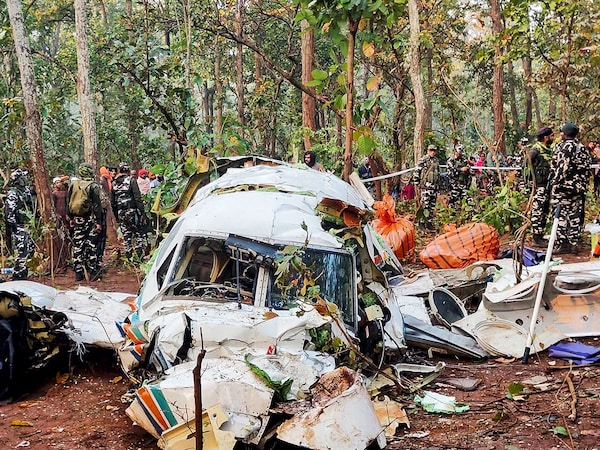
On Monday evening, a Beechcraft C90 air ambulance took off from Birsa Munda Airport in Ranchi at 7.11 pm and headed for Delhi with a critically ill patient. However, the aircraft went out of radar contact in less than 20 to 30 minutes and crashed into the forested region of Chatra district. The plane was later discovered deep in the forest, with all seven passengers on board dead.
The air ambulance, which belonged to Redbird Airways Pvt Ltd, had two pilots, a doctor, a paramedic, the patient and two relatives. According to reports, the aircraft had lost contact with Kolkata air traffic control minutes after take off and crashed about 100 nautical miles southeast of Varanasi. The local authority has confirmed that there was severe weather, including heavy rain, strong winds, lightning and thunder, reported during the time of the flight.
The victims have been identified as Captains Vivek Vikas Bhagat and Savrajdeep Singh, Dr Vikas Kumar Gupta, paramedic Sachin Kumar Mishra, patient Sanjay Kumar Shaw, and his relatives, Archana Devi and Dhuru Kumar.
Last week, 41-year-old Shaw from Latehar district had suffered burn injuries in a fire caused by a short circuit in the hotel he worked in. After days in a Ranchi hospital with little improvement, doctors told his family that a long road transfer to a specialised centre in Delhi would be fatal.
“We tried to take him by road, but the doctor said we couldn’t. He told us the patient might collapse on the way,” a relative told the news agencies. “So, we decided to take him by air ambulance.” The family also borrowed Rs7.5 lakh to pay for the air ambulance and subsequent treatment in Delhi.
Locals heard a loud noise during the storm, followed by signs of an explosion before the smoke appeared from the crash site.
Chatra Deputy Commissioner Keerthishree G told the media that the plane crashed in the panchayat area, deep inside the forest, after losing radar contact. “All seven people on board the air ambulance died in the plane crash,” she confirmed, adding that the plane had gone missing at 7.30 pm.
Later, the authorities sent an Aircraft Accident Investigation Bureau (AAIB) team to investigate the crash site and collect the flight recorders. Though the crash appears to have happened due to bad weather, the authorities said that the reason would be revealed only after conducting a thorough investigation.
When Lifesaving Flights Go Amiss
The Indian skies have witnessed air ambulances completing innumerable medical tasks, but some have also faced danger. The Ranchi plane crash is the most fatal in recent times, but it is not the first instance that has led to questions about aviation safety and emergency preparedness.
![]()
In May 2016, a Beechcraft King Air C90A air ambulance, flying from Patna to Delhi, experienced simultaneous engine failure as it approached the capital. Instead of being caught in the jaws of disaster, the pilot made a controlled crash landing in a field in the vicinity of Delhi’s Najafgarh area. All seven people on board survived with minor injuries, and the emergency services were praised for their efforts in preventing a bigger disaster.
This incident brought to the fore the natural risks associated with smaller aircraft and the paramount role of the pilot’s expertise, emergency training and rapid decision-making. At that point, the Directorate General of Civil Aviation (DGCA) pointed out that it emphasised the need for more defined rules regarding air ambulance services, which were still being developed.
In another incident in May 2021, an air ambulance with a patient undergoing a lung transplant suffered a gear failure while taking off from Nagpur. The crew decided to perform a belly landing at Mumbai Airport, which resulted in a safe landing despite the failure of one wheel. No passenger suffered injuries.
These incidents, however, are different from the Ranchi tragedy, where a combination of weather, geography and possibly unknown technical issues seemed to have worked against the flight.
Air ambulances play an important role in India, where specialised health facilities are not evenly distributed, and the distance between them and the patient’s location can be long. In most states, particularly in the eastern and northeastern parts of India, patients who need specialised health care face long road journeys. In such cases, air transport is not only a viable alternative, but the only medically feasible one.
The air ambulances, which are carried out using chartered planes such as Beechcraft turboprops, carry medical teams equipped to handle intensive care for patients during flight. These flights are not carried out in a normal environment, as they often involve: Late-night operations, marginal weather, tight schedules and sometimes limited ground support at smaller airports.
Apart from the necessary equipment and the competence of the flight staff, the availability of infrastructure that enables real-time weather information, improved boarding of technicians and effective decision-making support systems can go a long way in reducing the risks associated with air travel in emergencies.
DGCA Cracks Down on Charter Safety
In the aftermath of the Ranchi plane crash and the spate of aviation accidents involving non-scheduled operators, the DGCA has stepped up its monitoring of charter and air ambulance operators.
After analysing accident statistics over the last 10 years, the DGCA identified the need for improvement in the standard operating procedures, gaps in flight planning and training. The DGCA has now asked operators to give greater importance to safety than to their commercial obligations, making it clear that “a pilot’s decision to postpone, divert or cancel a flight due to safety reasons cannot be questioned”.
The major steps include increased audits, random checks of cockpit voice recorders, and increased monitoring of fuel, flight and maintenance records. The operators are also required to make public safety-related information such as the age of the aircraft, maintenance records and pilot experience. A safety rating system for non-scheduled operators is also being introduced.
The DGCA has also strengthened the enforcement of Flight Duty Time Limitations, with stricter penalties for non-compliance, and even extended the responsibility to the senior management. There is increased surveillance of older aircraft and improved weather-related training for pilots, as part of the new system that will ensure that emergency flights are conducted in a safe manner.
How Families Arrange Emergency Air Ambulances
In most cases, the decision to arrange an air ambulance is made as a last resort. The procedure begins with a medical evaluation. Doctors assess whether the patient’s condition is too critical to be transported by road or rail, or whether specialised care is only available in another distant city. In cases involving trauma, severe burns, organ transplants or cardiac emergencies, time constraints often make air transport the safest.
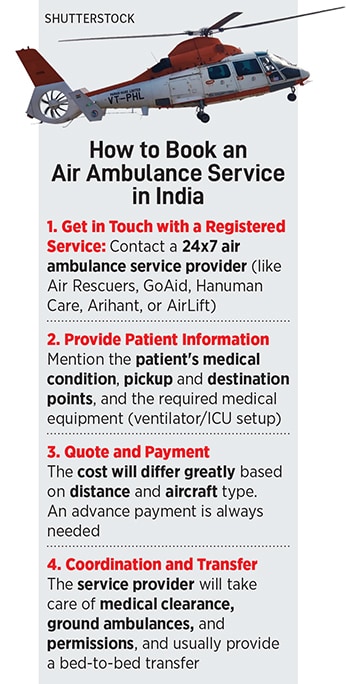
After the decision is made, the family contacts an air ambulance service or a charter company. Several private companies in India provide this service and credibility is paramount. The family must check whether the company has the necessary DGCA approvals, whether the aircraft is maintained in accordance with regulatory requirements, and whether the company has qualified medical staff with ventilators, monitors and emergency medications. Most companies have 24x7 hotlines that can be accessed through phone calls, WhatsApp messages or online inquiries due to the urgency of the request.
The booking involves the sharing of medical information, the patient’s condition, the points of departure and destination and any special equipment that may be needed. The operator is then able to organise medical clearance, coordinate with the departure and receiving hospitals, and set up the aircraft accordingly. The ground ambulances on both ends are organised as part of a bed-to-bed service to provide continuity of care.
However, cost is a significant factor. Depending on the distance, aircraft and the extent of medical support needed, an air ambulance transfer can cost anything from a few lakh rupees to much higher amounts for longer routes. Families can ask for a cost breakdown that includes aircraft expenses, medical staff on board and ground transfers. Advance payment or financial authorisation is usually needed before dispatch, considering the high operational costs involved.