Director of photography and filmmaker Manu Anand asserts there’s no escaping the artificial intelligence (AI) wave in the entertainment world. “It’s like standing on a beach, watching the tsunami come in and saying I am not going to learn how to swim,” says Anand, whose debut directorial, an AI film called Krishna, is in the pre-production stage. He feels the technology is going to be both transformative and disruptive, and “disturb a lot of people who come from the legacy processes”.
India is slowly but surely betting big on AI in films. A number of filmmakers and studios are making optimum use of the technology to tell stories they believe will resonate with the audiences and give them an experience to remember. Vijay Subramaniam, founder and group CEO of the Collective Artists Network, is one of them. His new-age media company released an AI-engineered web series, Mahabharat: Ek Dharmayudh, last year.
According to Subramaniam, the economics of the industry is in question. If one wants to tell an epic tale, for instance, does one always need to spend ₹400-500 crore? “That is not sustainable,” he says. It explains why he is gung-ho about the AI leap to assist content creation. “I am not driven by the technology… it is, for me, a medium. I’m driven more by the ability to tell stories,” Subramaniam tells Forbes India. “So, I don’t think I’ve jumped into it because AI is cool. I’ve jumped into it because there are enough stories that haven’t been told at the frequency that they were supposed to have been told because the commercial constructs do not support it.”
The box office has been experiencing an unprecedented lull since the Covid-19 pandemic. Some of the big-budget films with the biggest stars have failed to draw audiences to theatres.![]()
“Time is money. As soon as you accelerate certain things, your economics works out… from a producer’s perspective, when something that took two years to make comes down to one year, that is a huge benefit,” says Anand, a creative geek who has previously worked on VFX in films such as Fan, Zero and the Bhool Bhulaiyaa franchise.
Citing an example, Dipankar Mukherjee, co-founder and CEO, Studio Blo, a Mumbai-based AI filmmaking company, talks about an advertisement set in the backwaters of Kerala. “It was Onam and we had to shoot a tug-of-war sequence… now to get a crew to travel to Kerala and shoot the entire thing with crowd management would have been a nightmare. One can’t pull it off in 10 days, but with AI, we were able to,” he says. “The audience does not care whether it’s made with AI or not. They want a beautiful story. They want it to be believable, so if you can do that, everything falls in place.”
Studio Blo is collaborating with writer and filmmaker Shekhar Kapur on Warlord, a sci-fi series made entirely using generative AI. Mukherjee reveals that the Mr India director had been building the idea for some years now, but the tools available to make his dream come to life did not exist.
Mukherjee claims a lot of large technology players have shown interest in partnering with the studio in building this empire. “AI is extremely liberating. It gives you confidence,” he says. Earlier, whenever he would think of a script or a concept, he would not be sure whether it would get made, and wonder who he would have to convince to make it see the light of day. That has changed with AI becoming a breakthrough star in the world of content and cinema. “We are able to confidently march forward because of AI and say, yes, we want to do this, and that it doesn’t matter which part of the world we live in… some of the conversations we are having were impossible before AI,” says Mukherjee.
It’s still early days, but AI has shown that there’s a world of infinite possibilities if the technology is used constructively. Filmmaker Ram Madhvani launched Equinox Virtual three years ago when he decided to get into virtual reality (VR) more than AI when they weren’t the buzzwords. It has made a five-minute AI film, a retelling of the Bhagvad Gita through VR, the first interpretation of the text in the format. Equinox plans to develop 24 such films in the coming year and 100 around Indian mythology in three years.
![]()
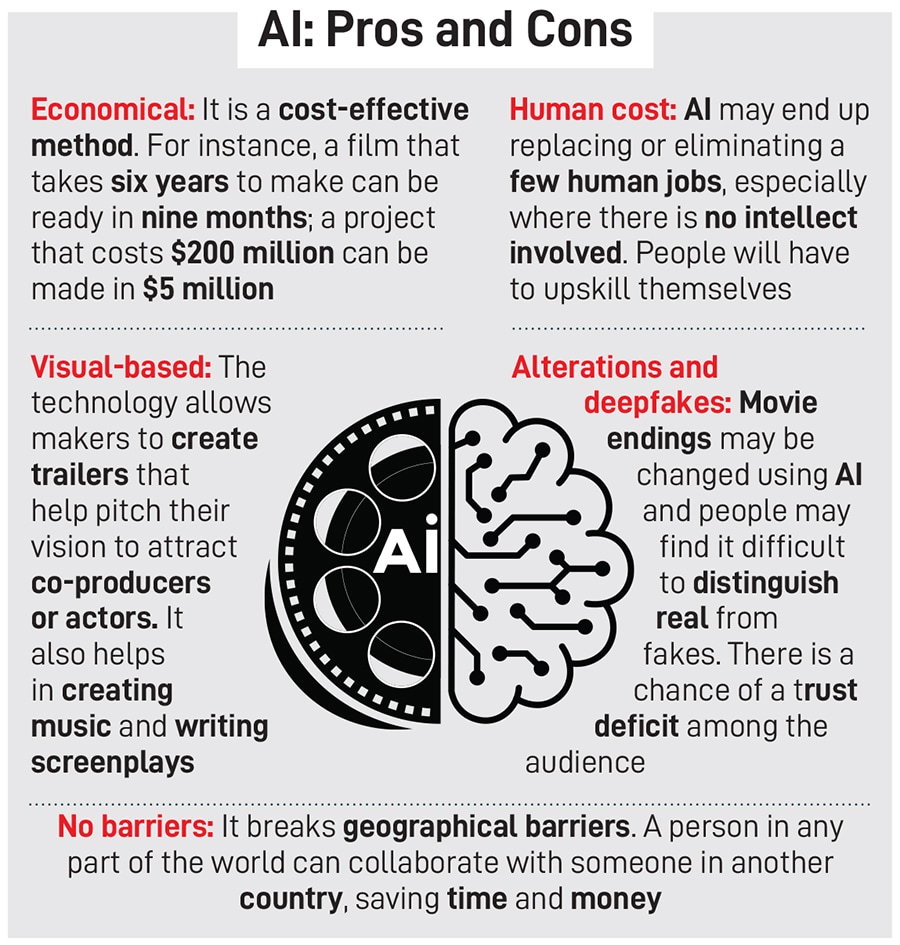
“There’s a lot of content coming out and we are currently using AI on many other stuff… it has been a great liberator. It is also a great brainstorming partner,” says Madhvani. The technology, he adds, has helped him with things like pitching his vision to attract a talent or a co-producer. “I can actually do a trailer with it. It has helped me tell people what I will be doing,” he explains.
The producer-director was shocked with the results when he used the technology for music. He reveals that he already has 30 songs generated by AI ready for a feature film. “That doesn’t mean I will not go to a music composer or a singer. But I am not going with a reference… I am going with the real thing and saying this is what I want. My efficiency between my idea and execution has been narrowed,” he says, while emphasising that it is also light on the pockets.
![]()
Subramaniam concurs, saying that because movie making is a director’s medium, being tech-first—with AI, animation, 3D—opens up a vast universe for storytellers and makes things simpler. “I can make a film that would otherwise take six years in nine months. I can make a $200 million movie in $5 million,” he says. “I can give my director the tools to visualise whatever he wants. If he wants an army of a thousand people overnight, he can. If he wants to shoot in the galaxy, he can. If he wants to shoot Mount Kailash, he can. If he wants to shoot in Haridwar, he doesn’t have to go there. One need not erect a set for three years to make Hastinapur; it can be done in a cost-effective way.”
The advantages are glaring, but so are the pitfalls and concerns. At the AI Impact Summit, actor-producer Rana Daggubati stirred a hornet’s nest by stating that AI will replace humans quickly.
Madhvani is unsure how such predictions will turn out, but feels unless technology uses technology, that won’t be the case. Subramaniam, too, dismisses the fear, calling it a “stupid argument”. He points out that he had employed 130 people for Mahabharat, including researchers, animators and graphic designers. “I think there will be new forms of jobs which people need to attract themselves to… everybody has to upskill,” he says.
Mukherjee of Studio Blo agrees. “Human craft and human ingenuity are irreplaceable. The quantum of humans required could reduce… so, anyone who is doing grunt work, where there is no intellect involved, they are at the risk of being replaced. They should probably upskill themselves with AI,” he says, adding that they are working with several production designers, cinematographers, directors and animation experts.
Data colonisation and Western indoctrination are things that Madhvani is wary about when it comes to using AI in filmmaking and storytelling. “If you see the Eastern or India stuff that is there in the data mining, it’s not enough. That’s my fear… is the data culturally rooted? How much of that data is genuinely our way of telling and seeing stories, which have a true Indian aesthetic? Also, the brainwashing of the repeated patterns of the way the stories should be is a concern. The question is how do we go back to our roots,” he says.![]()
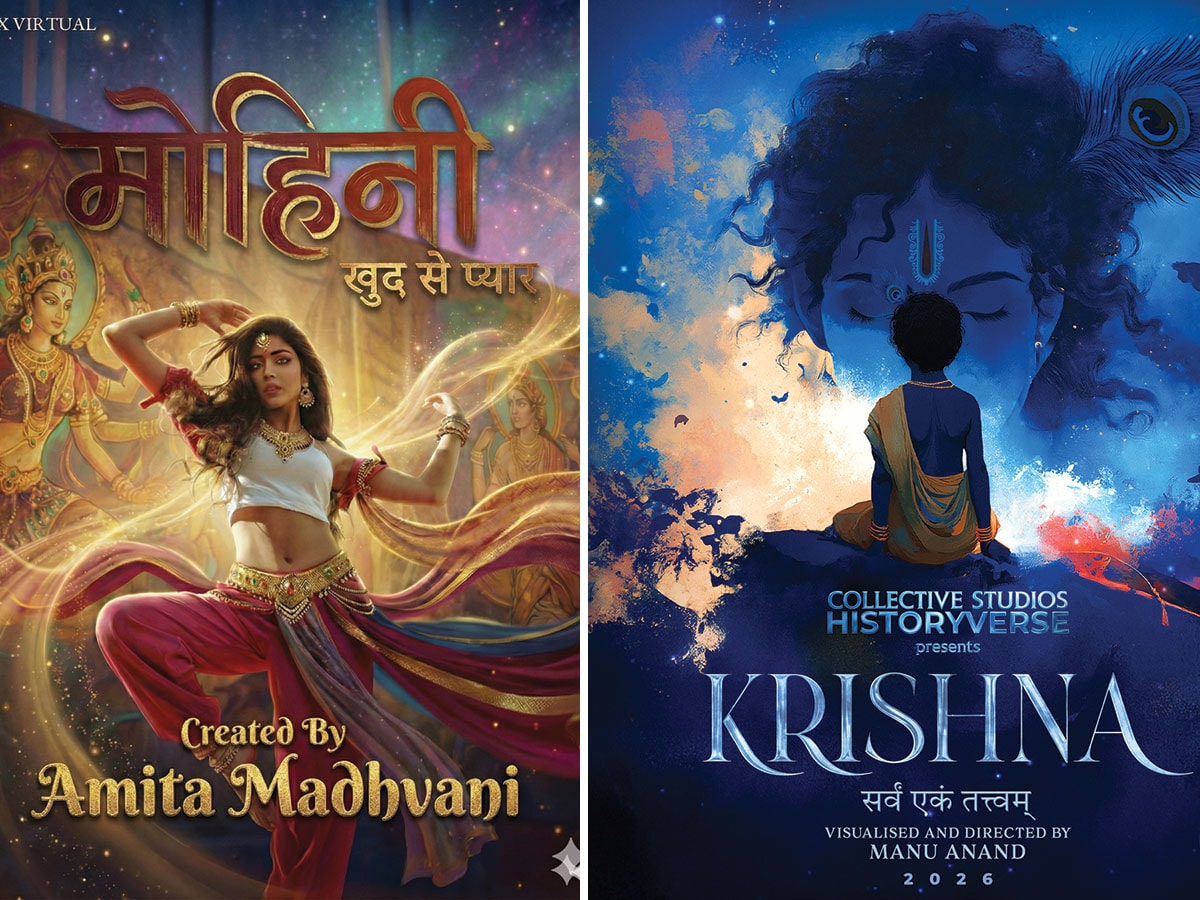
Mohini: Khud Se Pyaar is the first AI musical drama created by Equinox Virtual; (right) Filmmaker Manu Anand’s directorial debut is an AI film, Krishna
The big picture involving AI is hard to miss. Indian companies have the platform to provide world-class content for global audiences with a unique point of view. Mukherjee, however, feels we are squandering that chance. “The tragedy is that India is fast transitioning into this low-cost content delivery model once again with AI. There’s an opportunity for Indian creatives to come together and say that we will build the next Avatar here. And I really thought that would happen, but increasingly, what I am seeing is that we are again going the BPO or IT route… we’re just saying, hey, we are cheap and fast,” he rues.
The technology, of course, is continuously evolving and stakeholders feel there’s still a lot to learn from the AI universe. Subramaniam reveals that it was tough making Mahabharat because it was the first time a vast number of people were handling a new technology. “Technology is getting better. But AI is not yet there fully in terms of expressions, in terms of depth of emotion. And we are finding our substitutes for that,” he admits.
![]()
Manu is excited about what the future holds. “AI makes quantum leaps every week. It is such a quickly accelerated movement right now. Every time a new agent or a new version drops, there is a quantum leap,” he says. “The wary part, if I were to say something, is if the machines completely take over and there is no need for humans… then something is lost because when you’re directing, there is something that happens between an actor and a director. There’s something that happens with the energy of a crew that cannot be quantified; it is felt.”
Deepfakes and rewritten endings of stories are also problems related to AI that need immediate attention and solutions. The Tamil version of director Anand Rai’s 2013 film Raanjhanaa was re-released in 2025 with an AI-altered ending without his knowledge. The lead actor Dhanush and Rai both publicly expressed their displeasure, saying they do not endorse it.
An artiste has moral rights over their creation, but Manu laments the fact that there are contracts being pushed which ask creators to relinquish them. “A director’s vision should not be touched without his consent. And this goes beyond legal contracts… it’s a question of grace, and grace has become hard to find now,” he says.
Mukherjee feels as the technology gets stronger, it will be hard for audiences to gauge whether what they are seeing is real or fake. He says: “I think there will be a deficit of trust.”
For now, AI is thrilling and tempting, and the entertainment world believes what it has explored is only the tip of the iceberg.
Equinox Virtual, for instance, is set to release its first AI musical drama, Mohini: Khud Se Pyaar, created by co-founder Amita Madhvani this year. “I am excited because AI allows me to create a new ecosystem. Currently it is based on return on investments [RoI], Friday collections and people who are exhibiting what I make. This [AI] allows me to create a new avenue, an entire new RoI ecosystem which is not based on traditional methods,” says Madhvani. “We are embracing AI in both ecosystems—in the traditional world using new technology and by founding a new system with AI.”
One thing is sure—AI will bring about rapid changes. And the industry will have no choice but to accept and adapt to those. “My hypothesis is that advertising and ad filmmaking as categories will be replaced by AI by the end of this year because those don’t fit in the economic model,” says Mukherjee. “Traditional cinema will survive, but pre-visualisation will be completely done by AI.”
The debate on man versus machines will continue, but as Madhvani puts it: “The prompt engineer is the artist of the new world.”