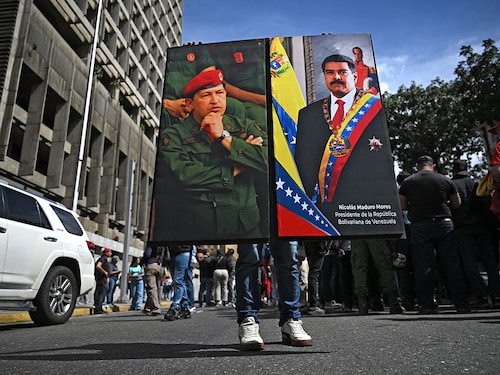
Venezuelan President Nicolás Maduro and his wife, Cilia Flores, were captured by United States forces on January 3, 2026, after a large-scale military operation in Caracas. The couple was flown to the US to face federal drug and weapons charges, which US President Donald Trump confirmed in a press conference at his Mar-a-Lago resort in Florida on the same day the operation occurred.
US authorities said Maduro and Flores would appear before a federal court in Manhattan on charges linked to drug trafficking and weapons offences, including narco-terrorism conspiracy and cocaine importation conspiracy, under a superseding indictment filed in the Southern District of New York.
The operation caught many governments off guard, raising immediate questions about Venezuela’s leadership vacuum, the legality of the action under international law, and what comes next for a country already facing prolonged economic collapse and political fragmentation.
At a press briefing, Trump said the US would temporarily oversee Venezuela during a transition period, though he offered limited clarity on governance arrangements or timelines. He also indicated interest in US companies playing a role in rebuilding and developing Venezuela’s oil infrastructure.
According to US government statements and media reports, the operation began in the early hours of January 3. US military strikes were carried out at multiple locations in northern Venezuela, including areas near Caracas, as part of what officials described as “Operation Absolute Resolve.” US special forces, including Delta Force units, apprehended Maduro and Flores before transporting them to a US Navy vessel and then to New York, where they were taken into custody.
The action marked a rare instance of a sitting head of state being captured by the military of another country and brought to face domestic criminal charges. Legal and diplomatic experts have questioned the legality of the operation under international law. Reuters reported that the 15-member UN Security Council was expected to discuss the issue during meetings scheduled for January 5.
Immediate Effects in Venezuela
Following Maduro’s removal, Vice President Delcy Rodríguez was declared interim president by Venezuela’s Supreme Tribunal of Justice. Rodríguez initially denied knowledge of Maduro’s whereabouts but called for his release, while asserting her authority as constitutional head of state in his absence.
Defence Minister Vladimir Padrino López also released a video statement condemning the US action and warning against any foreign military presence on Venezuelan soil. Pro-Maduro demonstrations were reported in parts of Caracas following the strikes.
International reactions were divided. Argentina’s president welcomed the move, while leaders in Brazil and Mexico condemned the US action as a violation of Venezuelan sovereignty and international law. Several Latin American governments called for UN mediation. China and Russia, long-time allies of Caracas, accused the US of breaching international norms.
India’s Ministry of External Affairs said on January 4 that it was “closely monitoring the evolving situation” and urged “peaceful dialogue” to ensure regional stability. It also advised Indian nationals in Venezuela to exercise caution, avoid non-essential travel, and remain in contact with the Indian embassy in Caracas.
Also Read: Venezuela falls: Vast oil, growing OPEC Share, but trade with India shrinks
Why this Matters Now
Maduro’s capture removes the central figure of Venezuela’s government but does not resolve the country’s underlying political, economic, or security crises. Control over institutions, the loyalty of the military, and the legitimacy of interim authority remain uncertain.
Trump’s statements about overseeing Venezuela during a transition and involving US oil companies have been met with criticism. A spokesperson for UN Secretary-General António Guterres told Reuters on Saturday that the US operation had set “a dangerous precedent”.
From Chávez to Maduro: How Venezuela’s System Collapsed:
Hugo Chávez and the Bolivarian Project
Hugo Chávez first gained national prominence in 1992, when he led a failed military uprising against the government of President Carlos Andrés Pérez. Although imprisoned following the attempt, Chávez later built a political movement and was elected president in 1998 on a populist platform centred on social justice and anti-corruption rhetoric.
After taking office in 1999, Chávez launched the Bolivarian Revolution, combining expanded social spending with increasing executive control. High oil prices funded ambitious welfare programmes, while key industries were nationalised and political power was consolidated around the presidency.
Chávez strengthened ties with Cuba, Russia, China, and Iran, while adopting a confrontational stance towards the US. These policies reshaped Venezuela’s institutions but also increased long-term economic vulnerability.
Maduro and Economic Unravelling
Nicolás Maduro assumed the presidency in 2013 following Chávez’s death. His rise coincided with growing economic fragility, amplified by Venezuela’s near-total dependence on oil revenue.
The collapse in global oil prices in 2014 triggered a severe downturn in the country. Output fell, imports collapsed, shortages deepened, and inflation surged. Political tensions escalated after opposition parties won control of the National Assembly in 2015. Maduro responded by creating a parallel constituent assembly, weakening legislative checks on executive power.
Presidential elections in 2018 and 2024 were widely criticised by international observers, citing irregularities and restrictions on opposition participation.
Collapse of the Bolívar and Hyperinflation
Venezuela’s economic breakdown was most visible in its currency. After years of deficit financing and monetary expansion, the country entered hyperinflation in late 2016. By 2018, Venezuela’s central bank reported inflation of 130,060 percent for the year. Independent estimates, including those by the International Monetary Fund, suggested inflation may have reached into the hundreds of thousands or higher. The Bolívar rapidly lost purchasing power, pushing much of the economy into informal dollarisation. Multiple currency redenominations failed to restore confidence.
The breakdown of Venezuela’s economy was closely tied to the collapse of its oil industry, long the backbone of state finances. According to data from the Organization of the Petroleum Exporting Countries, Venezuela’s crude oil production fell from more than 2.5 million barrels per day in the early 2000s to well under 1 million barrels per day by the early 2020s. Ageing infrastructure, lack of investment, mismanagement, corruption**,** and the impact of sanctions all contributed to the decline, depriving the government of foreign exchange and worsening fiscal stress.
The 2024 Election and the Machado Factor
Venezuela’s political crisis deepened after the 2024 presidential election. Opposition candidate Edmundo González ran in place of María Corina Machado, who was barred from holding office. Independent observers and parallel vote counts cited by international bodies indicated González had won a majority, but electoral authorities declared Maduro the winner without releasing detailed tallies.
Machado rejected the result, calling it fraudulent. The government responded with arrests, protest restrictions, and intensified pressure on opposition figures.
Humanitarian Collapse and Mass Migration
Economic decline translated into a prolonged humanitarian emergency. Shortages of food, medicine, and basic services became widespread, while crime rose and infrastructure deteriorated. According to the UN High Commissioner for Refugees and the International Organization for Migration, between 7.7 million and 7.9 million Venezuelans have left the country since 2014, creating one of the world’s largest displacement crises.
Human Rights Watch has documented widespread poverty, the collapse of public healthcare, and systematic repression. The Center for Strategic and International Studies has linked Venezuela’s crisis to long-term policy failures, collapsing oil production, and institutional decay.
India’s Oil Engagement with Venezuela
India historically maintained significant oil ties with Venezuela, though these have diminished sharply. United Nations COMTRADE data show India imported about $1.76 billion worth of Venezuelan crude in 2024, far below earlier peaks.
ONGC Videsh holds a 40 percent stake in the San Cristóbal oilfield and minority interests in the Carabobo-1 project. Sanctions, payment restrictions, and PDVSA’s production collapse have stalled operations, with industry estimates placing unpaid dues and stranded investments at close to $1 billion.
At its peak, India imported more than 400,000 barrels per day of Venezuelan crude. By financial year 2024–25, imports had fallen below $300 million.
What Happens Next
Delcy Rodríguez’s interim leadership remains contested, and it is unclear how long military and institutional support will hold. With legal scrutiny at the UN and divided international responses, Venezuela will likely face a prolonged period of uncertainty.
Rebuilding the oil sector and stabilising the economy will also require sustained investment, policy reform, and political clarity. For now, Maduro’s removal marks another turning point in Venezuela’s long crisis.