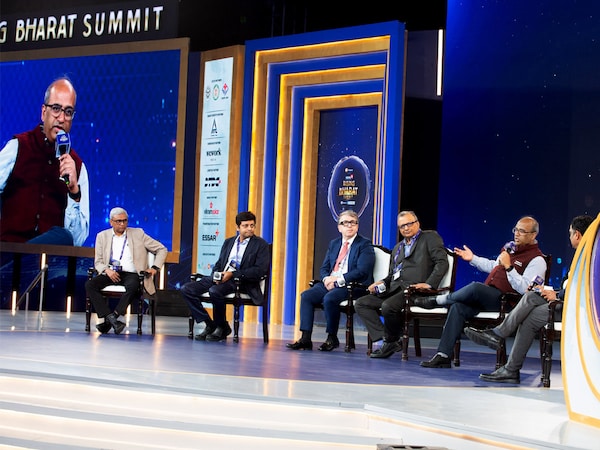
(From right) Abhishek Singh, Additional Secretary, MeitY speaks with panelists
Shashi Shekhar Vempati, Co-Founder DeepTech, Bharat Foundation; Spiros Margaris, Venture Capitalist & Founder, Margaris Ventures; Dr Nagendra Nagaraja, Founder, CEO & Chairman, QpiAI and Sunil Gupta, Co-founder & CEO, QNu Labs at a panel on 'Bharat's Encryption Theorem: AI, Capital & Capability' at the Rising Bharat Summit in New Delhi on February 28, 2026.
Photo by Madhu Kapparath
India will need to expand artificial intelligence (AI) computing capacity, strengthen domestic technology capabilities, and invest in cybersecurity to remain competitive in the global technology race, industry experts said at the Rising Bharat 2026 event on Saturday.
Speaking during a fireside chat followed by a panel discussion, Abhishek Singh, Additional Secretary at the Ministry of Electronics and Information Technology (MeitY), said scaling computing infrastructure remains a priority as AI adoption expands across sectors.
“Even if 100 million to 200 million people start using these services, we will need to expand the backend infrastructure,” Singh said. “So 100,000 to 200,000 GPUs is something that is the minimum that we will need to meet the demand of India.”
Singh said the current capacity, which includes about 38,000 graphics processing units (GPUs) deployed, with more in the pipeline, is sufficient for early development but not for population-scale deployment.
He added that the government is working on policies to incentivise private investment in computing infrastructure, while public funding would support applications in sectors such as agriculture, healthcare, and education, as well as strategic uses.
On domestic AI models, Singh said locally developed systems would improve with greater adoption, particularly in Indian languages and contexts: “The more we start using it, the more we start using it in Indian languages, the more we start using it in Indian contexts, they will become better versions of what they are.”
India’s experience with large-scale digital public infrastructure has also created trust among developing countries seeking AI partnerships, he added.
“The Global South looks at India as a trusted partner... there is a lot of belief and trust,” Singh said.
AI tools must support India’s language diversity
Shashi Shekhar Vempati, co-founder of DeepTech at Bharat Foundation, said India’s linguistic diversity could become an economic opportunity if AI tools are built to support voice and regional languages.
“India’s language diversity is often seen as a barrier, but it is also a great opportunity. With models like Sarvam and voice-based systems, you can open up opportunities to every part of India,” he said, adding that AI could even help remove barriers to commerce and services across regions.
Innovation is strong, but global perception needs improvement
Venture capitalist Spiros Margaris said India’s innovation ecosystem is strong, but its global perception needs improvement, particularly in communicating achievements internationally.
“There is so much talent here that India should one day—and I hope sooner rather than later—play on the same level as America or China. But it takes time,” he said. Margaris also dismissed concerns that the current surge in AI investment represents a speculative bubble.
“I don’t think it’s a bubble. I lived through the dot-com bubble in America, and then companies like Cisco built infrastructure for start-ups, many of which didn’t survive. What we are building now with AI infrastructure is for companies that have so much cash flow that it’s not a bubble. The volatility in the market is just part of it—like life. People expect a straight line, but there are setbacks. The direction is clear,” he said.
Dr Nagendra Nagaraja, founder and CEO of QpiAI, an AI and quantum computing firm, said quantum computing could help address complex scientific and industrial challenges that conventional systems cannot solve efficiently.
“If you want to solve real problems, the value of technology comes from the impact it creates. Quantum computing can address fundamental challenges—in healthcare, materials, fertilisers—areas that have huge implications for humanity,” he said.
Sunil Gupta, co-founder and CEO of QNu Labs—which specialises in quantum cybersecurity—added that advances in AI and quantum technologies are increasing risks to digital security, particularly encryption systems that protect financial and communication networks.
“In the post-AI and quantum world, there is no digital economy without digital trust. Trust today lies in encryption and data protection. Both AI and quantum computing are threatening current encryption methods, which means the world is moving towards quantum-safe security,” Gupta said. “In the digital economy, countries need to own encryption keys. If we miss this opportunity, we may have AI and quantum technologies but not true sovereignty.”
Gupta also stated that India is already among the leading countries in quantum communication technologies.
Focus on Sovereign AI: Sarvam AI
In a separate session earlier in the day, Pratyush Kumar, co-founder of GenAI start-up Sarvam AI, also highlighted the importance of building domestic AI capabilities while continuing to use global technologies where necessary.
“Doing end-to-end is what gives AI models the sovereignty… otherwise you are dependent on other players,” Kumar said. “While we should continue to use all the AI models, there should be an increased focus on having sovereign alternatives,” he said.
Kumar added that collaboration between humans and AI could become a strength for India, given the country’s openness to technology adoption.