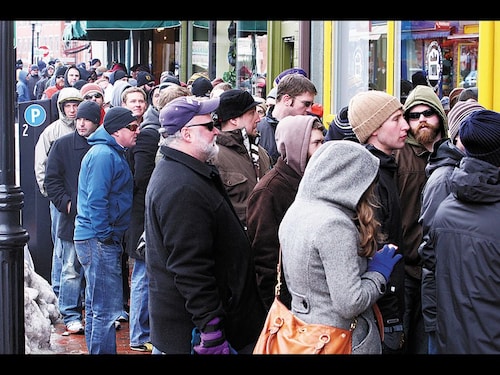
It’s like the 1960s’ groupies waiting for a glimpse of Jagger or Richards backstage. Instagram and the rise of ‘hype beers’ have seen an increase in fanatical enthusiasts who wait outside brewery gates for a new line of craft beer on the day of its launch. “People spend the night in the parking lot,” said Henry Nguyen of California’s Monkish Brewing Company to The New York Times in February 2017. “It was about 15 hours of waiting, sometimes for only six cans.” Image by Boston Globe/ Getty Images
Grand Rapids in the state of Michigan have earned it the title of ‘Beer City’ because of its vibrant craft beer industry that produces small and balanced batches. Along the city’s Beer City Ale Trail there are 60 breweries, while the local calendar is filled with beer festivals, events and promotions. You can take a pick from among the Great Lakes Pub Cruiser, the Grand Rapids Motor City Brew Tour from Detroit, or a GR Hopper Pass.
Image by Courtesy Experience GR
The term ‘Bed & Brew’ was coined in 1994 by Fredericksburg Brewing Company in Texas at its brewpub where guests had pint on the house before retiring upstairs. The concept has gained popularity since then, and includes Glenwood Canyon Brewing Co at The Hotel Denver (in photograph) in Colorado, Woodstock Inn in New Hampshire, Calistoga Inn Restaurant and Brewery in Napa Valley, Jasper Murdock’s Alehouse in Vermont, and the Seneca Lodge in New York.
Image by Courtesy: The Hotel Denver
Belgians are more loyal to the yeasty, earthy notes of traditional ales brewed by the trappist monks of Belgium since the 18th century (when the wandering monks fleeing the French Revolution settled in Belgium). Anyone who has drunk a Chimay Blue or Duvel would know them by their pedigree. Brewed within the walls of a monastery and principled as a non-profit venture, the revenue from the beers cover the living expenses of the austere monks, and the rest is donated to charity. The slightly sweet beer has a relatively high level of alcohol, with flavours of spices.
Image by Francois Lenoir / Reuters
Craft beer labels have become as unique as their ingredients, with artwork fit for galleries. For instance, Neshaminy Creek features gnomes on its labels, drawn by JP Flexner, while Omnipollo features Karl Grandin’s work. Collectors of labels believe they are a medium for artists to explore their talent.
Image by Courtesy: Neshaminy Creek_JP Flexner
Japan has not been as open to the possibilities of craft beer. Laws prohibiting the practice of home-brewing and a large tax on drinks with higher malt content have made beer expensive. Some brewers resort to being inventive: They used peas and corn to cut the amount of malt, while others circumvented laws that prevented the use of fruit extracts, spices and other ingredients in beer. Following the loosening of brewing laws in 1994, there has been a rise of craft beer in the country, with breweries such as Coedo Brewery in Saitama making beer from sweet potato. Image by Buddhika Weerasinghe / Getty Images
When the British were expanding their power over the Indian subcontinent, George Hodgson, a London brewer in the 1700s, used his connections to dominate beer export market to India. To preserve the beer for longer periods in hot conditions, he brewed it with extra hops and with higher alcohol levels. It made other brewers in England brew a pale ale that displaced the London brews and came to be called Indian Pale Ale (IPA). In the Indian subcontinent, IPA is not common, and the launch of Little Devils in 2009 in Delhi by TVB Craft Breweries was a sort of homecoming. In 2017, two more IPAs were launched: One from Gwalior-based White Rhino Brewing Co, and the second being Bira 91s. Image by Ann Ronan Pictures / Print Collector/ Getty Images
The association between India and Britain over beer has taken on myriad forms. One example is Bundobust, a collaboration between restaurateur Mayur Patel and Mark Husak of the Sparrow Bier Cafe of Bradford. With outlets in Manchester and Leeds, it serves raft beer from local breweries like Manchester's Cloudwater, and complements the drinks with vegetarian food.
Image by Tom Joy / ilikepress
Hops, one of the four main ingredients - along with water, malted barley and yeast - of beer, has been declared the 'herb of the year' by International Herb Association this year. Hops, which adds the bitter taste and aroma to beer, has been added to beer since 7th millennium BC. In later times, it was cultivated in Germany and used in French and German monasteries. Prior to hops, beer was flavoured with spices and herbs such as juniper, coriander, cumin, nutmeg, oak leaves, lime blossoms, cloves, rosemary, gentian, gaussia, and chamomile. Image by AAron Ontiveroz /The Denver Post via Getty Images