Sustainability stack: DPI architecture for India’s sustainability leap
IIM B’s Sustainability Stack applies India’s DPI model to unify fragmented EES data, mapping 42 entities across seven layers to enable interoperable, real time, city to ward sustainability intelligenc
By Srinivasan R., Chaitrali Bhoi, Ruchi Chaurasiya and Abhishek Chavan
India is grappling with complex sustainability issues, marked by systemic gaps that must be addressed to achieve the nation’s net-zero commitment by 2070. Photo by Shutterstock
Advertisement
India has redefined scalable governance and population-scale orchestration through its Digital Public Infrastructure (DPI) achievements—from authenticating 1.4 billion citizens via Aadhaar to enabling 16 billion monthly transactions through UPI. The Indian Institute of Management Bangalore’s Centre for Digital Public Goods (CDPG) is now extending these proven approaches with its proposed Sustainability Stack, a sector-agnostic DPI framework that integrates fragmented Economic, Environmental, and Social (EES) data into a unified digital system.
CDPG is pushing boundaries even further by proposing a Sustainability Stack grounded in DPI principles. This framework aims to integrate economic, environmental, and social governance (EES) data into a unified, interoperable system, with the potential to redefine how corporations, governments, and communities carry out sustainability efforts.
India is grappling with complex sustainability issues, marked by systemic gaps that must be addressed to achieve the nation’s net-zero commitment by 2070. Regulatory complexity further compounds these challenges, resulting in inefficient decision making and inaccurate reporting. Vast datasets collected by departments such as water boards, electricity boards, pollution control boards, and municipal corporations often remain confined within silos.
The JICA-BCG Forest Stack, a layered DPI architecture for ecological management and governance, inspired the Sustainability Stack’s blueprint. The Forest Stack validated a registries-based orchestration approach capable of converting siloed forest data into a decision-intelligence system. In contrast, the Sustainability Stack expands this DPI approach to integrate fragmented data across urban water, energy, waste, and land-use systems.
Analysis and Solution Provision
The proposed Sustainability Stack introduces a dashboard-based sustainability assessment for urban systems and identifies ecosystem entities to address departmental data silos. The major advancements proposed include:
Role-based entity selection, linking actors to EES impacts, including non-traditional influencers such as delivery platforms and informal vendors whose behaviours affect outcomes.
Unified performance metrics, standardising indicators such as per-capita energy use, waste segregation rates, and service equity to enable comparability.
Systemic entity inclusion, explicitly incorporating quasi-government authorities (such as water boards and development authorities) often omitted in reporting frameworks.
These advancements enable analysis from aggregate city totals to disaggregated entity- or ward-level data, exposing losses, inefficiencies, and systemic disparities. Sustainability planning often encounters Jevons’ efficiency paradox, which holds that efficiency gains can trigger rebound effects through higher usage or longer operating hours, thereby increasing overall consumption. The Sustainability Stack accommodates monitoring and evaluation through real-time metering, behavioural nudges (such as peer comparisons), and time-of-day pricing to ensure efficiency translates into net savings.
Sustainability Ecosystem: 42 Entities Mapped Across Seven Functional Layers
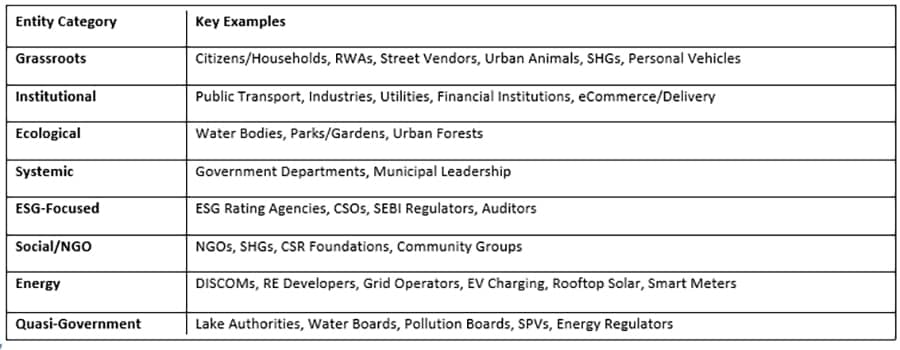
The key differentiator of the Sustainability Stack’s design is its entity-based ecosystem mapping. Rather than focusing solely on government departments, it accounts for 42 sustainability-related entities across seven functional categories, each with granular Economic, Environmental, and Social (EES) performance metrics. This approach captures the true essence of a public–private partnership within a DPI framework. These entities are distributed across seven categories, as shown in Table 1.
Table 1: Seven Categories for Sustainability Stack Ecosystem Entities Mapping
Sustainability Stack’s Layered DPI Architecture
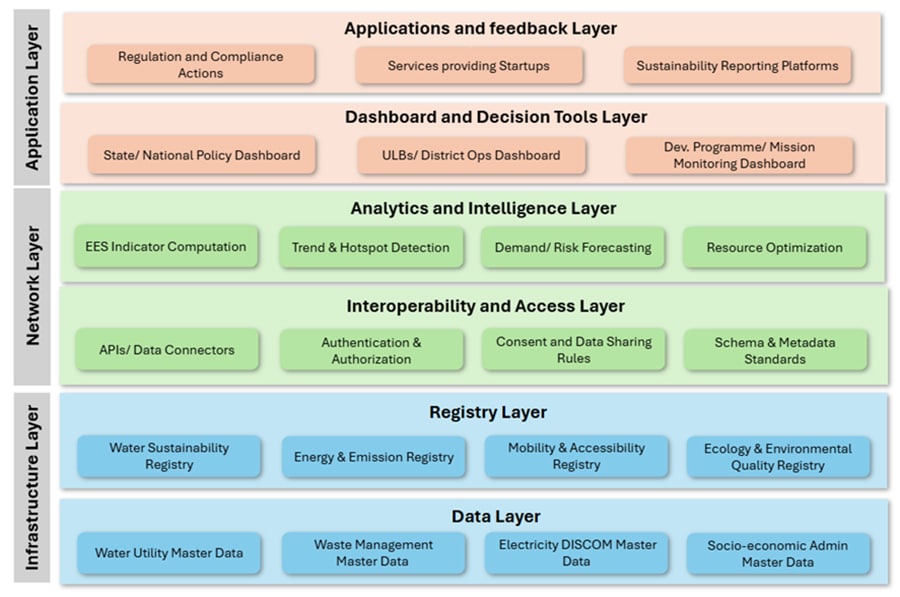
The proposed six-layer Sustainability Stack is built on QUAD DPI design principles. These principles, jointly established in 2024 by Australia, India, Japan, and the United States, define the necessary design foundations for DPI development. They emphasise interoperability, modularity, extensibility, scalability, collaboration, intellectual property protection, security, privacy, governance for public benefit, trust, transparency, sustainability, grievance redressal, and alignment with sustainable development goals.
Layer 1 consists of master data systems (e.g., utility databases). Layer 2 comprises registries for orchestration. Layer 3 covers APIs and standards. Layer 4 manages analytics and decision intelligence. Layer 5 provides stakeholder dashboards, and Layer 6 delivers applications with feedback loops. The schematic representation of this six-layer DPI architecture is shown in Figure 1.
Figure 1: Schematic Illustration for Six-layered DPI Architecture of Sustainability Stack
The Sustainability Stack positions registries as its core innovation, distinguishing them from traditional departmental databases. This is essential for addressing fragmented silos and facilitating interoperability across regions and ecosystem entities. It proposes minimum viable registries (water, energy, ecology) operating across EES domains, enabling actions such as targeted leakage reduction or proactive demand management—potentially transforming reactive reporting into anticipatory governance.
Sustainability Stack’s Governance Framework
The stack proposes a citizen-centric governance framework in which registry-based orchestration is central. For pilot-scale implementation, nodal authorities (such as municipalities and urban local bodies) and registry custodians (such as water boards) must be designated. The stack leverages data stewardship through DEPA-compliant agreements, citizen-centric engagement, and a calibrated balance between economic and ecological outcomes.
Citizens interact with the stack in multiple capacities: as data principals (providers of data), data consumers, application developers, and service providers. For-profit corporations can benefit by creating dashboards to measure and monitor sustainability initiatives, realigning their sustainability strategies, and allocating resources more effectively. State governments, municipalities, and government departments can leverage the Sustainability Stack to design policies, ensure regulatory compliance, and align efforts with development goals, including the UN Sustainable Development Goals.
Conclusion
The proposed Sustainability Stack aims to transform fragmented sustainability data systems into a sector-agnostic, registry-based DPI offering decision intelligence across economic, environmental, and social (EES) domains. Its contributions include:
Sustainability ecosystem entity mapping (from grassroots to quasi-government)
Unified EES entity performance metrics
A six-layer DPI architecture built on QUAD principles
A redefinition of aggregated and disaggregated sustainability data through minimum viable registries
The Sustainability Stack can be scaled across diverse global contexts—including developing and advanced economies. DPI design principles will allow the Sustainability Stack to scale and deploy globally while ensuring sovereignty at all levels.
Srinivasan R. is Professor of Strategy and Chairperson, Center for Digital Public Goods, IIM Bangalore. Chaitrali Bhoi is Research Associate, Center for Digital Public Goods, IIM Bangalore. Ruchi Chaurasiya is MBA’26 candidate, IIM Bangalore. Abhishek Chavan is MBA’26 candidate, IIM Bangalore.
This article has been published with permission from IIM Bangalore. www.iimb.ac.in Views expressed are personal.