India’s plastic consumption and waste generation have both increased dramatically over the past five years. While consumption was at 19.8 million tonnes in 2019-20, and growing at a CAGR of 9.7 percent, waste generation is at 3.4 million tonnes up from 1.6 million tonnes in 2016-17 and growing at a CAGR of 20.7 percent, says the Marico Innovation Foundation’s (MIF) ‘Innovations in Plastics: The Potential and Possibilities’ report. Of the total 3.4 million tonnes waste generated, only 30 percent is recycled, the rest finds its way into landfills.
It has been 150 years since plastics came into being, but today they are practically irreplaceable. In such a situation, what’s the way around? “Plastics have now become one of the largest issues. On one hand, we cannot do without it, but on the other, the rate at which we are consuming it… we have reached a stage where we just cannot sustain it," says Amit Chandra, honorary chairperson, governing council, MIF and chairperson, Bain Capital India. A disruptive solution is the need of the hour. If there is one place where the lack of an effective recycling plan is most visible, it is the towering waste landfills in India.
Involving key stakeholders
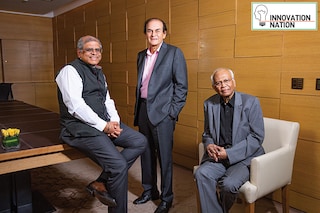
The goal is to turn into a circular economy—focussing on eliminating waste and reusing products and materials, for which every stakeholder—civil society, the government and the private sector—needs to be involved. “I think this needs to get attention from all the stakeholders and it needs a lot of collaboration because if all the stakeholders work unitedly, only then will we feel the impact," says Harsh Mariwala, founder, MIF. The foundation is working with close to 15 different startups, to help them scale up and create a large scale impact.
But when it comes to implementation of changes for a sustainable future, Chandra says, “it needs an enabling policy framework". For instance, he adds, “If you look at recycling, today there is no incentive for me to dump one trash can versus five or for me to segregate my waste. Put a cost on consumers for dumping garbage." Though the government has taken initial steps for single-use plastics, Mariwala feels, “it needs to play a far more proactive role, such as introducing landfill taxes".
The industry is also extremely unorganised at the moment. “Sorting of waste is done manually currently, which eventually means the quality of recycling is not good," adds Mariwala.
A holistic approach needs to be taken, involving everyone starting from raising awareness among civil society. “Though most people do understand that there is a problem, when it comes to plastics, they don’t understand the scale of the issue," adds Chandra.
Innovation: The need of the hour
There are many young startups that are innovating within the circular economy. However, as per MIF’s report in CY21, the entire circular economy sector only got $6 million in funding, as opposed to edtech, which got $5788 million or fintech, with $5077 million. Additionally, there are no unicorns from this sector in India.
Read More
“I was shocked by how little money actually goes into these startups," says Chandra. “You need to showcase to the investor community that there is a problem that exists at scale, and can be solved profitably—because investors will only pour money if they see these two things." Additionally, the lack of value chain consolidation and asset heaviness could also be factors limiting funding.
There are startups working on AI-based technologies for dry waste segregating (Ishitva Robotic Systems), making sustainable bricks from recycled waste (Angirus), recycling used sanitary napkins in a hygienic manner (Padcare), using low value multi-layered packaging waste to create construction panels (Ricron) and more. The challenge, however, is the implementation of these technologies at scale. Plastics is and will always continue to be a cheaper option. “When compared to plastics, at this stage the products/services offered by these startups will be more expensive. But over time as it achieves scale and some government incentives, the cost should come down," explains Mariwala.
For MIF, working on this report with Indian Institute of Science and Praxis Global Alliance as knowledge partners is just the beginning. He adds, “We have a broad theoretical framework with this report, but ultimately we want to go ahead and find practical ways to really create an impact on ground."