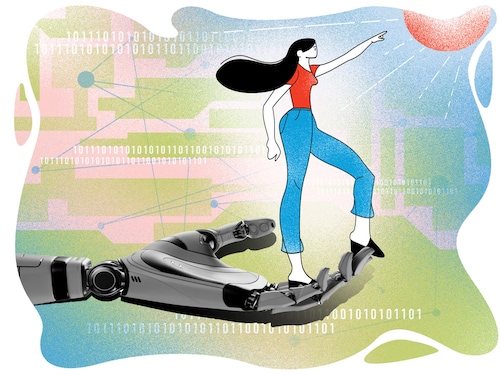
AI isn't just an assistant; it's your teammate: Rohan Murty
An AI co-worker absorbs processes, protocols and data from the repeated actions of the team, and presents insights and solutions much faster than its human counterparts, the founder of Workfabric AI /
When you embed an AI co-worker into the pyramid of people, the shape of that pyramid begins to shift, flattening hierarchy and decentralising control.
Illustration: Chaitanya Dinesh Surpur Image: Shutterstock
Advertisement
What changes when every team has one
Co-pilots lift individuals, helping each person write faster, code faster, reply faster. But AI co-workers lift teams. They learn from the group’s shared routines, fill gaps between roles, and surface insights no one person would catch on their own. That’s not just productivity, it’s coordination.
Misalignment across teams is a silent killer cross-functional context mismatches cause 35 percent of initiative delays in large enterprises. AI co-workers reduce that drag by preserving shared context and flagging disconnects before they cascade.
Once the AI co-worker is embedded, three shifts surface almost overnight. Pace accelerates. Meetings shrink because recaps and missing-item checklists arrive beforehand email chains shorten because the AI reconciles numbers and contract terms in real time. Onboarding is shortened. In many Fortune 2000 firms, onboarding for complex roles takes over eight months. But when a new hire can ask, “How did we price feature X last year?" and get an annotated answer in seconds, time-to-contribution shrinks dramatically. Teams become fluid. Context travels with the project, not the humans, letting talent flow to priority work without losing the thread. Organisations begin to look less like pyramids and more like networks of pop-up crews that form, deliver and dissolve as priorities shift.
But something deeper also happens. You now have a co-worker who has silently absorbed how everyone else works. It understands how the designer structures briefs, how the tech lead evaluates risk, how the product manager prioritises trade-offs. It knows the shortcuts seniors use, the sticking points that slow juniors down, and the workarounds that teams apply when the process breaks. In effect, it becomes a reflection of the team’s best-known work patterns—pitfalls included. That memory isn’t static it evolves as the team evolves, offering nudges not just from the past, but from a collective understanding of what works here.
This fundamentally shifts how teams operate. Most organisations still design teams as pyramids: More juniors at the bottom, fewer seniors at the top, a central manager directing traffic. But what happens when you add an AI co-worker to that pyramid? What’s the right ratio: One per team, one per pod, one per function? What skills does the team lean on the AI for, and which stay human? Management now has to account for this new axis in team construction—not just headcount, but AI model count.
The AI co-worker isn’t a peer in title, but it is a peer in influence. It changes how quickly decisions get made, how reliably knowledge travels, and how much oversight is needed. It blurs the boundary between hierarchy and infrastructure. A pyramid with an always-on, cross-cutting node starts to behave less like a stack of roles and more like a coordinated system.
Learning the ropes without jargon
Teaching an AI co-worker looks disarmingly human. During the first weeks it listens more than it speaks, watching which draft survives edits, which metrics trigger fire drills, which wording customers respond to. Once confident, the AI makes tentative moves—suggesting a standard header, flagging a missing attachment, surfacing last year’s pitch that tackled a similar problem. The team corrects it in plain language: “Not that chart, the other one." Those corrections tighten future suggestions.
Because learning happens inside the same secure environment where the work already lives, nothing proprietary leaks outside the firewall, and because the teachers are the practitioners themselves, no one needs a PhD in data science to improve the system. On the user’s side, the process ought to feel no more exotic than onboarding a new colleague: You show it how your team works, where the information to get work done sits, explain the quirks, it asks clarifying questions, and within a sprint or two it’s pulling its weight.
The secret is simple: The AI co-worker learns by noticing how work gets done in the team. Not from training manuals or formal processes, but from the everyday flow—where teams click, what they reference, which tools they open in which order. These small, repeated signals add up to a kind of working rhythm unique to each team. Over time, the AI picks up on those patterns and starts to support them, offering help that feels timely, relevant and familiar.
Over time, teams begin to rely on their AI co-worker not just for reminders or suggestions, but as a source of collective recall—“What’s our usual escalation path when this vendor delays?", “Didn’t we test this onboarding flow before?"—questions that no one person remembers, but the AI does.
The three shifts everyone notices
When the co-worker is fully embedded, daily life changes fast. First, pace accelerates. Meetings shrink because recaps and missing-item checklists arrive beforehand email chains shorten because the AI reconciles numbers and clauses in real time. Second, onboarding compresses. Institutional memory—once trapped in veterans’ heads—now lives in the AI’s recall. A newcomer asks, “How did we price feature X last year?" and gets the annotated answer in seconds. Third, teams become fluid. Context travels with the project, not the humans, letting specialists flow to priority work without losing the thread. Companies begin to look less like pyramids of fixed departments and more like networks of pop-up crews that form, deliver and dissolve as priorities shift.
The gains are not theoretical. Pilots in software, manufacturing and health care report 25-to-50 percent drops in turnaround time without shrinking headcount.
Disruption without the drama
For years the AI conversation has swung between utopian promises and dystopian fears. The AI co-worker offers a more grounded narrative. It neither replaces the team nor sits mutely at the edge of the screen. Instead, it absorbs repetitive chores, stores tribal knowledge and leaves humans to negotiate, invent and empathise, tasks that still resist automation.
Will jobs disappear? Roles will certainly evolve. The employee who once spent mornings reconciling spreadsheets may now spend that time advising clients or experimenting with a new product idea. The risk is not obsolescence the risk is clinging to workflows designed for an era when information moved no faster than the slowest typist. Companies that adapt will find they can tackle more ambitious projects with the same headcount because the invisible tax on collaboration has been lifted.
This is not theoretical. An AI co-worker can instantly surface institutional memory, cutting down the 30 percent of time knowledge workers spend searching or recreating existing work. At the same time, it can shrink onboarding timelines by 40 to 60 percent, accelerating productivity. And by maintaining persistent, cross-functional context, AI co-workers reduce delays caused by misalignment, thus allowing teams to form, act, and adapt faster than ever.
In the end, disruption is rarely about the innovation itself. It is about the behaviour innovation makes possible. The smartphone mattered less as a phone and more as a platform that let millions open and manage their finances, access public services, hail a ride, record a song or pay a bill while standing in line for coffee. The AI co-worker will matter less as an algorithm and more as a catalyst that lets any collection of professionals—five marketers, eight engineers, three nurses on a ward—operate at the speed and sophistication once reserved for elite, deep-pocketed institutions.
That is a future worth embracing, and it starts not with grand strategy decks but with a simple question at the next team meeting: What could we accomplish if our newest colleague already knew everything we learnt the hard way?