Richest countries in the world 2025: Top 10 by GDP per capita
Curious about the richest economies in the world? In this post, we list the top countries by GDP per capita ranking in 2025
By Forbes India
Last Updated: Dec 18, 2025, 15:52 IST6 min
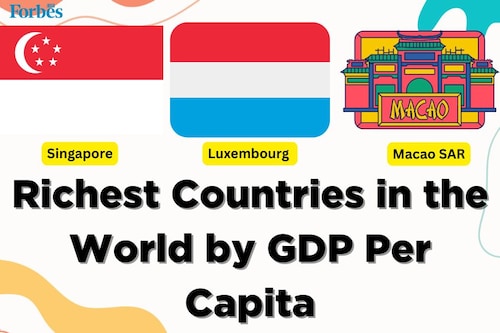
When we talk about wealth at the national level, it’s easy to get caught up in total GDP figures, which only tell us the size of a country’s economy.
But GDP per capita - the average economic output per person - gives a clearer picture of individual prosperity and living standards. This measure helps us understand how wealthy people in a country might be on average, rather than just how big the economy is.
In this post, we’ll explore the top 10 richest countries in the world by GDP-PPP per capita in 2025, offering useful insights into which nations provide the highest economic well-being to their residents.
Gross Domestic Product (GDP) measures the total value of goods and services produced in a country. By dividing this number by the number of full-time residents, we get an idea of the general populace’s wealth. However, a more precise measure of a nation’s wealth considers inflation rates and the costs of local products and services.
By considering both factors, we derive the Purchasing Power Parity (PPP). While this may still not be absolute statistics to accurately rank the richest and poorest countries in the world (as some wealthy countries are tax havens, artificially inflating their GDPs with external wealth), the GDP per capita ranking (accounting for PPP) still gets us close to understanding the wealth held by various nations.
| Rank | Country | GDP-PPP Per Capita (in USD) |
| 1 | Liechtenstein | 201,112.3 |
| 2 | Singapore | 156,969.1 |
| 3 | Luxembourg | 152,394.6 |
| 4 | Ireland | 147,878.2 |
| 5 | Macao SAR | 132,648.3 |
| 6 | Qatar | 122,283.2 |
| 7 | Norway | 106,694.1 |
| 8 | Switzerland | 97,659.2 |
| 9 | Brunei Darussalam | 94,472.4 |
| 10 | Guyana | 94,189.3 |
While smaller countries like Luxembourg and Singapore benefit from well-regulated financial sectors and tax regimes ideal for foreign investments into their economies, bigger and more powerful countries like the US and China rank lower in the list of richest economies.
A closer look: Top 10 richest countries by GDP per capita ranking 2025
In recent years, Liechtenstein has strengthened its global integration, including joining the IMF in October 2024 and fully implementing the OECD’s Pillar 2 global minimum tax rules as of January 2024.
In 2024, the Economic Development Board (EDB) secured $13.5 billion in fixed-asset commitments, particularly in the manufacturing sector, reinforcing its position as a reliable global production hub.
Singapore Green Plan 2030 Initiative, launched in 2021 charts ambitious targets for sustainable development and net-zero emissions, positioning the nation for future green growth and attracting investments in related tech and sustainable finance.
The Luxembourg Green Exchange has listed over €1 trillion in sustainable bonds, positioning the nation as the EU’s top green finance hub.
The nation has successfully attracted a large number of US tech (Google, Apple, Meta) and pharmaceutical (Pfizer) companies to establish their European headquarters. These firms contribute a huge portion of the national GDP.
Ireland’s implementation of the OECD’s global minimum corporate tax rate (15%) for large multinationals demonstrates its commitment to international tax cooperation while seeking to maintain its competitive edge.
Plus, as a condition of license renewal in 2022, gaming concessionaires committed to investing over $13 billion into non-gaming projects, further supporting diversification efforts.
The casino and tourism industry is the central pillar of Macao’s economy, often generating more revenue than Las Vegas. This sector contributes a majority of the GDP and government tax revenue.
The National Development Strategy was launched in early 2024 to further diversify the economy away from hydrocarbons.
Commitment to environmental sustainability is evident in new projects like the Al Kharsaah Solar PV Power Plant and expanding Carbon Capture and Storage technology, positioning Qatar in the future green economy.
Instead of immediately spending all oil revenues, the government channels nearly all petroleum profits into its Government Pension Fund Global (GPFG), the world’s largest sovereign wealth fund (valued at over $2 trillion in 2025).
A strict fiscal rule dictates that only the expected return (around 3%) from the wealth fund’s capital can be used annually in the national budget. This prevents economic overheating and preserves the fund for future generations.
The country invests heavily in R&D and boasts world-class universities and research institutions (like ETH Zurich), fostering continuous innovation and technological advancement.
The financial sector has successfully navigated recent global banking turbulence (such as the 2023 Credit Suisse acquisition by UBS), consolidating its position as a stable and reliable global center for wealth management.
Brunei Darussalam’s economy grew by 4.2% in 2024, its fastest expansion since 1999, driven by a strong rebound in both upstream and downstream oil and gas sectors, placing it among the fastest-growing ASEAN economies during that period.
The country has also become a leader in climate finance by monetizing its vast, intact rainforests through carbon credit sales, earning considerable revenue.
1. What is the GDP per capita ranking of India?
As of September 2025, India’s GDP per capita is $2880 (Nominal) and $12,130 (PPP). In the GDP per capita ranking for 2025, India stands at the 124th position out of approximately 200 countries. In terms of overall GDP rankings, India ranks 4th in the world, following the USA, China and Germany.
2. Which country has the lowest GDP per capita?
According to the GDP per capita ranking 2025, South Sudan has a GDP per capita (PPP) of $716.25, making it the poorest country in the world.
First Published: Dec 18, 2025, 09:09
Subscribe Now