Home or overseas education: Which is better?
Founder and CEO of RAYSolute Consultants decodes the return on investment from studying abroad
Last Updated: Apr 23, 2024, 12:09 IST5 min
a privilege reserved for the super-rich and residents of metros, mini-metros, and Tier I cities. The availability of financing options, scholarships, hybrid learning is allowing students even from Tier II and III cities to access international education.
While STEM (science, technology, engineering and mathematics) and career-focussed courses are preferred by many to be pursued in countries like the US, some students are also exploring non-STEM areas such as environmental, life & biomedical sciences, law, business, social sciences, humanities, renewable energy, liberal arts, tourism, hospitality, fashion and culinary arts. This point towards the shifting interest of students in a more holistic and interdisciplinary education.
To facilitate this global education exchange, there are several country-specific associations, which promote their higher education programmes within India, such as EducationUSA, NAFSA, DAAD (German Academic Exchange Service), British Council, Austrade, Study Australia, Universities Australia, Campus France. Students looking to pursue international education should watch out for information or events from these organisations to make an informed decision.
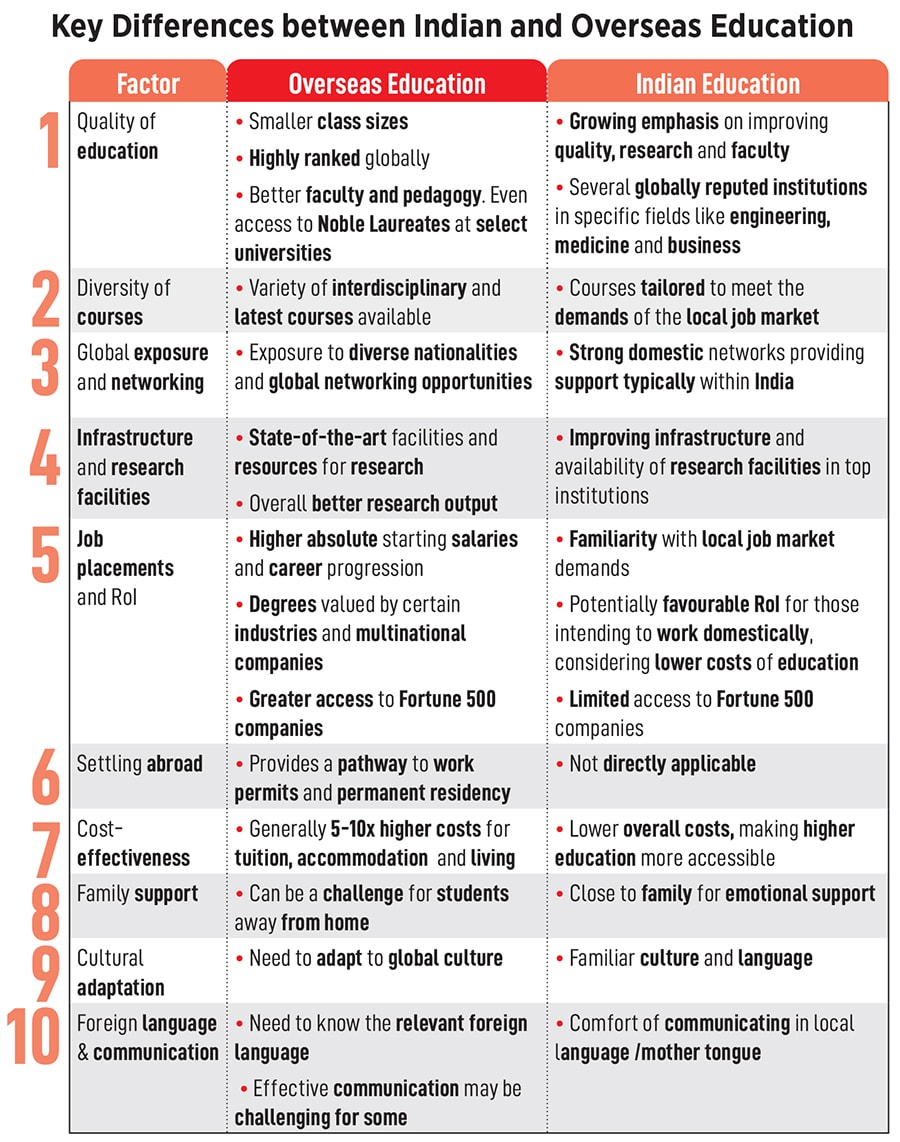
In India, the ethos of value consciousness is deeply ingrained in the consumer psyche. This is evident even in scenarios where a customer is planning to buy a luxury car invariably inquires about its mileage. This trait of seeking value or return on investment (RoI) is also evident when families make the financial and emotional decision to send their kids for overseas education. Families view studying abroad as not only an education opportunity but also as a pathway to settling abroad.
The financial RoI of higher education can be calculated using the following simple formula: RoI=(net return on investment/ cost of investment) x 100. Here, the net return on investment is calculated by subtracting the total cost of investment (including tuition fees, accommodation cost, other living expenses, interest on education loans and opportunity costs) from the total earnings (to be adjusted for taxation, time value of money and forex rates) over a defined career span postgraduation. The cost of investment includes all expenses incurred during the education period.
The RoI from higher education hinges on several critical factors, including cost, earnings potential, career span and strategic educational choices. Opting for government-funded institutions in India or leveraging scholarships and in-demand skills abroad can yield a higher RoI. However, the financial risk of studying abroad on loan warrants careful consideration of postgraduation employment prospects. Students and their families may use the above methodology to closely evaluate their choices to make informed decisions that maximise their RoI. It may be noted that the above calculations are based on averages and assumptions, which can vary widely. It also does not take into account some of the non-financial benefits into account such as personal development, networking, range of career options, work-life balance etc.
Given the current landscape of geopolitics, visa restrictions, feasibility and safety of studying abroad, the decision of whether to study in India or abroad should be taken at least two to three years in advance. Both the choices involve a different strategy and planning to get into top universities and courses..
With the advent of artificial general intelligence (AGI) and advanced robotics, the shelf life of many careers may quickly diminish, while some new job roles could emerge. Students should therefore initially focus on acquiring transferable skills, which are universally valued across industries such as creativity, emotional intelligence, complex problem solving and understanding of mental health.
Whether choosing to study in India or abroad, students are encouraged to pursue opportunities with a global and interdisciplinary mindset, ensuring that their education aligns with their career aspirations and personal growth objectives.
First Published: Apr 23, 2024, 12:09
Subscribe Now