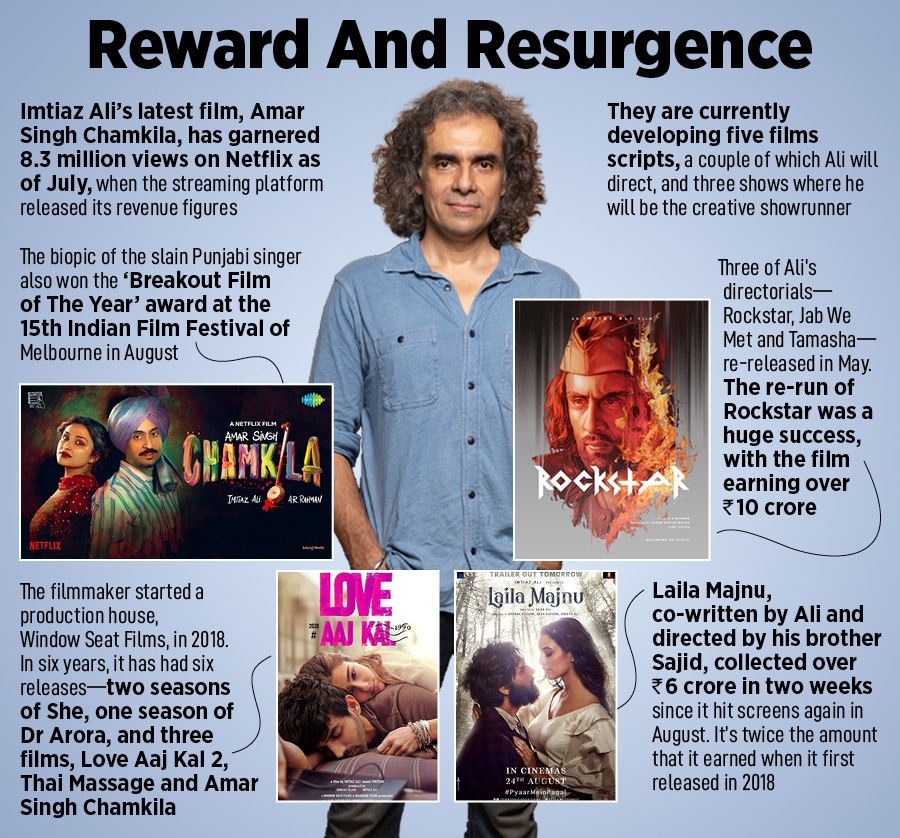
“I didn’t have a parameter to my expectations. I didn’t have a perspective on what to expect, but yes, the response was overwhelming," Ali tells Forbes India. He has every reason to feel jubilant. After all, the success of Amar Singh Chamkila—his debut OTT release as a filmmaker—comes after the box office failures of his last two directorials, Jab Harry Met Sejal (2017) and Love Aaj Kal 2 (2020). The 53-year-old, though, has a realistic take on the fate of films. “The junta [audience] is always right, that’s the way I’d like to think," he says.
Ali then moved to Mumbai to pursue a diploma in advertising from the Xavier Institute of Communications. “I didn’t get a job as a copywriter after my course. As a result, I got into doing things that are more related to films," he says. Subsequently, he began directing television serials such as Kurukshetra for Zee TV and Imtihaan for Doordarshan. The thrill of bringing an idea to life and the joy of calling the shots from behind the camera gave the lanky, curly-haired storyteller the ultimate high.
Eventually he veered into filmmaking, directing his first movie, Socha Na Tha, in 2005. It took four years to make the film, and the resultant hassles meant that Ali had to step in for aspects where a director need not get involved—cinematography, accounts, procurement. “I learnt everything from that experience," he says, adding, “At that time, I just wanted the film to get over and for it to be released. But now I realise that it was also film school for me. It seemed like a big deal then, but I am extremely happy in retrospect."
![]()
Socha Na Tha got due recognition, but it was his next, Jab We Met (2007), that made people take notice of Ali as a filmmaker with substance. The film starring Shahid Kapoor and Kareena Kapoor Khan in lead roles not only worked its magic at the box office, but it also remains a timeless classic to date. Ali’s work thereafter—Love Aaj Kal (2009), Rockstar (2011), Cocktail (2012), Highway (2014) and Tamasha (2015)—earned him a distinct place among modern filmmakers. His films that often deal with romance, heartbreaks and travel became the subject of conversations.
“My stories come out from imagination. But this imagination is rooted in something that I have seen in my life in reality," says Ali, adding that filmmakers are audiences and human beings first. “Every film you make demands a different style of storytelling. And I would like to believe that I try to have a different style of storytelling in each film."
***
Diljit Dosanjh, who plays the title role in Amar Singh Chamkila, was under the impression that since he was from Punjab, he knew everything about the slain singer whose life he was to essay on screen. But he was pleasantly surprised when he spoke with Ali who seemed to know much more about Chamkila, the artiste and the person. “His level of detail and dedication were truly inspiring," says Dosanjh.
“Working with Imtiaz Sir was a unique experience. His clarity about what he wanted made my job as an actor much easier. He had a deep understanding of Chamkila’s story, character and his conflicts, and he came in extremely well-prepared."
Unlike his previous works, Amar Singh Chamkila was a unique film to make for Ali since it followed the life and times of a person. It was not fiction. “I had to go with facts," he says. “It had a lot of mixed media—animation, titles on screen—and the storytelling was different. Also, it was a musical film. Another thing that I liked was that it had a rural setting. The character was a disadvantaged, impoverished person from a village whose mentality was different from mine. It was refreshing to go there, make that journey, and depict that," he adds.
A real-life tale meant a lot of primary research. For over two years, Ali spoke with multiple people in
Chamkila’s life to extract information and understand the singer’s perspective. Dosanjh reveals that the filmmaker’s inputs helped him play the character effortlessly. “One interesting thing that he did during our prep work was that he would send me emails every other day with insights about Chamkila—for instance, how he might think or react in certain situations," says the actor-singer-composer. “Imtiaz Sir was prepared and had a clear vision… he knew how Chamkila would stand, talk and behave, down to the smallest detail. I followed his instructions closely. His perspective of Chamkila as a human being, beyond his public persona, helped me and the entire crew bring a realistic portrayal of his story to life. Working with Imtiaz Sir on
Amar Singh Chamkila was a dream come true."
Rahman, who composed the music for Amar Singh Chamkila, his fourth collaboration with Ali, finds it a joy to work with him because they both “strive for excellence". “This film presented the challenge of narrating the life of a singer who met a tragic end. Imtiaz’s brilliance lies in his ability to take a seemingly ordinary story and transform it into something grand and cinematic," says the two-time Grammy winner. “In Chamkila, we weren"t glorifying the singer for his controversial lyrics but rather highlighting the human story behind his life. This ability to find and showcase the deeper humanity in his characters is where Imtiaz has truly evolved as a filmmaker," he adds.
***
Those who have seen Ali closely since his formative years are not surprised at his talent and the sensitivity to his craft that he has displayed. In him, they always saw a person floating with ideas who was ready to push the creative envelope. Mohit Choudhary is one of them. “I met Imtiaz first in 1991 when I joined Hindu College. He was a year senior to me and president of our dramatic society. I acted in a play called Holi that he had directed, and we reversed roles the following year in another play titled Neem Hakeem Khatra Hain in which Imtiaz played the main protagonist," recalls Choudhary. “He is pretty much what he was then… highly creative and extremely driven. He was sure he wanted to be a writer-director."
Though both went their individual ways—a B-school graduate, Choudhary took up corporate jobs before quitting in 2012 to get into film PR and marketing-communications [he worked on Highway and Tamasha]—they came together for Window Seat Films, Ali’s production house that completed six years in May.
![]()
Ali concedes that no matter how hard he tries, it takes a year-and-a-half for him to write and direct a film. The process, he admits, can happen a lot quicker. That led to the realisation that the many stories that he has in his mind may never get made given the pace at which he works. “I was unwilling to let go of so many stories that may never see the light of day. That led to the creation of Window Seat Films in 2018 wherein we thought we will get other people to work on these stories that I have created," he says.
Window Seat Films has already had six releases—two seasons of She on Netflix, one season of Dr Arora on Sony Liv, and three films, Love Aaj Kal 2, Thai Massage and Amar Singh Chamkila. “I find I am doing much more with my time or at least there is much more demand on my time which I feel great about," adds Ali, who is now keen on expanding the team.
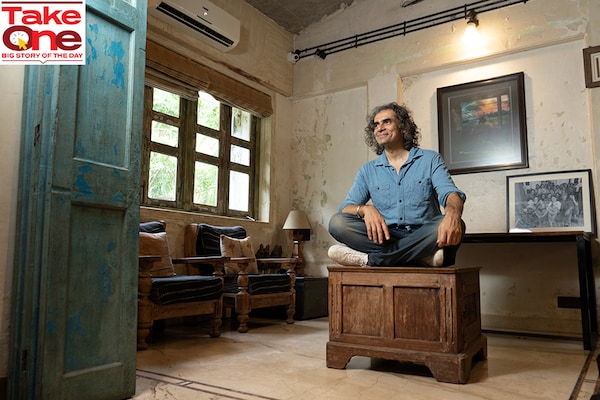
Choudhary, who was producer on Dr Arora, Thai Massage and Amar Singh Chamkila, explains that he handles the production aspect of the business while Ali is more involved on the creative side. “I am the master brewer. In this company, I handle creativity and tea making," chimes in Ali, who’s dressed in an olive green shirt, jeans and sneakers, while making Darjeeling tea at the production house’s bungalow-office in Mumbai’s Versova, Andheri, that has an old-world vibe to it with wooden flooring and furniture.
The familiarity of knowing each other for over three decades is an added advantage. “It’s a collaboration where two partners complement each other. In our case, we know our strengths and shortcomings, and that helps. It’s a satisfying way of running a business," explains Choudhary, who leans on his corporate experience to take decisions. “The good thing is that not that I think I am very smart with money and economics, but we have been profitable. The return to investment has been positive. Now I feel we will be able to do more," adds Ali, who is in the midst of developing five films scripts, a couple of which he will direct, and three shows where he will be the creative showrunner.
***
It’s the excitement of telling stories that brought Ali from Jamshedpur to Mumbai. He insists he’s here to make films, not analyse them once their destiny is sealed. That doesn’t interest him. At the same time, he’s not averse to criticism. “For me, praise and criticism have to be handled positively, else both can damage you," he says. “What I do not like, though, is a biased point of view. One has the prerogative to not like a film, but not because of an agenda. Unfortunately, in business, there will always be agenda."
As a filmmaker, he remains unruffled though. One sets, he has a Zen-like attitude, says Choudhary, who is producing partner at Window Seat Films. “He gets increasingly focussed as the chaos goes up. His energy rubs off on everyone," he says.
The director is also someone who does not judge a film only by box office performance, as he believes there are “many other numbers that one needs to consider". “Although I am attached to how well a film of mine does, I do not agree with seeing the film industry like a stock exchange because that is not my game. I will make movies if people want to watch them," Ali tells Forbes India. “There are big numbers to movies that you don’t remember one year later. And I cannot be bogged down by the rat race. I will always try to make my movies more popular. I love it when that happens."
The popularity that he is referring to can be gauged from the fact that of the five films that re-released in theatres in May, three—Rockstar, Jab We Met and Tamasha—were directed by him. In fact, people flocked to the theatres and made Rockstar a big success, with the film earning over Rs10 crore during its re-run. Similarly, Laila Majnu, co-written by him and directed by his brother Sajid, collected over Rs6 crore in two weeks since it hit screens again in August. The amount is twice the figure that it earned when it first released in 2018 and more than the collections of some recent films.
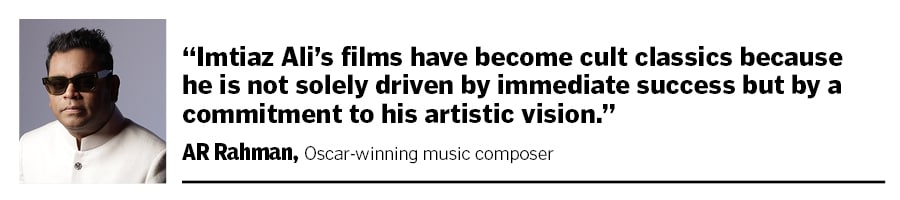
“Imtiaz Ali"s films like Rockstar and Tamasha have become cult classics because he is not solely driven by immediate success but by a commitment to his artistic vision. If we can achieve both critical and commercial success, it’s fantastic. But even if we don’t, it doesn"t diminish the value of our work," explains Rahman, adding that the filmmaker has a keen understanding of music and lyrics, and comprehends the creative process, which is crucial. “Imtiaz is a unique filmmaker with a distinct thought process, and we have vibed well together. Our relationship is more of a creative friendship than a traditional director-composer dynamic," he continues.
Agrees Dosanjh, who was amazed with what he saw in Rockstar. “The music in his films is unmatched. He uses music as a significant storytelling tool, which is rare in today’s filmmaking," he says.
The comfort of watching films on streaming platforms has meant that the audiences make an informed choice before deciding to go to the theatres. They need value for their money. Ali is conscious of the changing times, but that hasn’t altered his style of storytelling. “You have to make every film good for it to be good. One film being good does not mean the follow-up film will also be exciting for the audience, especially for the audience today," he says, adding that OTT has given storytellers the gift of duration and detail.
***
Outside films, Ali likes doing “regular and boring" things. “I find reasons to travel to the places I want to. I have a lot of friends who waste a lot of my time, and I waste theirs," he says. Choudhary reveals that the two things the filmmaker really focuses on are his tea and lunch. “The joke is that we plan our shoots around places where we can get good food," he says.
Ali says whichever city he travels to, he makes it a point to go to all the unmarked eateries. And there are some joints in obscure places like the gullies and far-flung corners of Delhi which have his photographs because he has eaten there. “It gives me a lot of pride. I am the endorser of cheap street food," he smiles.
![]()
It’s not just him. His stories have also travelled through the lanes and bylanes, and touched a chord with people which is why they demand more out of him than just the nine films that he has directed in nearly two decades.
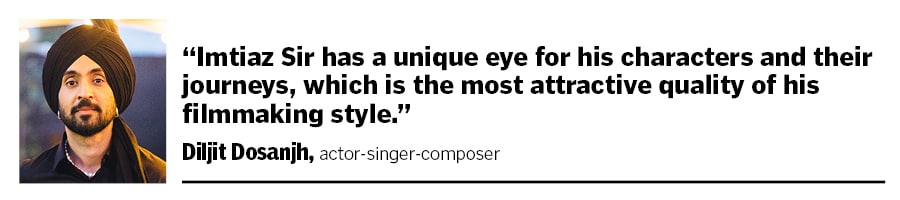
“I have been a fan of Imtiaz Sir’s work. He has a unique eye for his characters and their journeys, which is the most attractive quality of his filmmaking style," says Dosanjh. “The ability to find and showcase the deeper humanity in his characters is where Imtiaz has truly evolved as a filmmaker," explains Rahman.
Ali is aware of the high expectations. He says he has written a new script and has another in the works. And then there’s the other content being churned out at Window Seat Films. “After I complete a film, I like to get on with another one because it’s the start of another adventure. I am eager to start another adventure," he says. There’s no ‘comeback’ when it comes to Ali. He’s sure he is here to stay.