Shea: The better butter
It has not just changed the way we eat chocolate and moisturise our skins, but the manner in which women live in the heart of Africa
Last Updated: Feb 23, 2019, 06:47 IST9 min
_s.jpg?im=Resize,width=500,aspect=fit,type=normal)
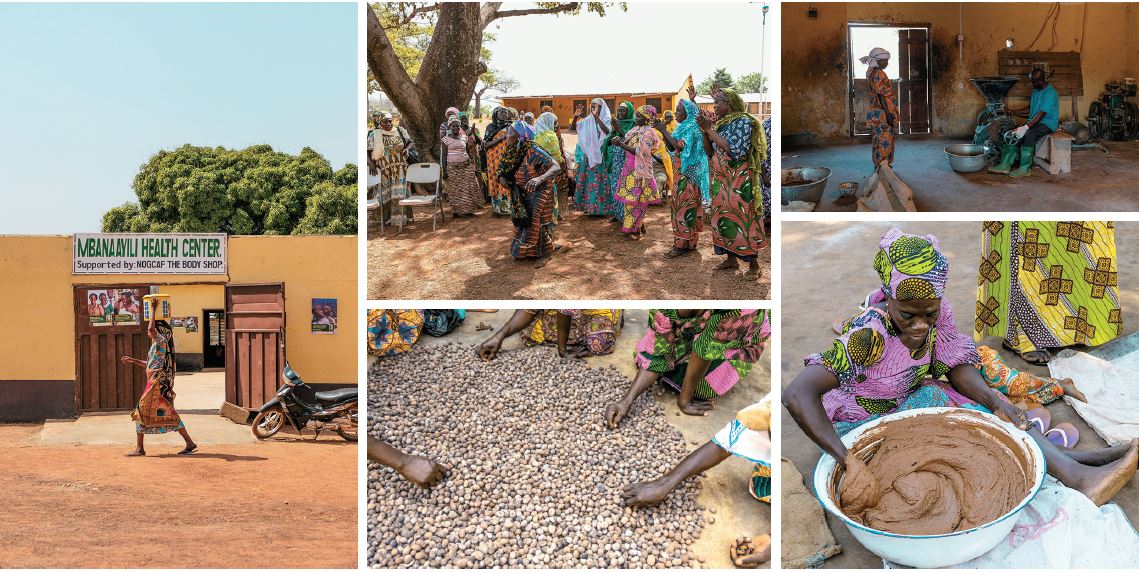 (Clockwise from left) The Mbanayili Health Centre women in Mbanayili dance beneath kapok trees shea kernels being crushed by a machine to make butter the churning of shea paste to extract butter women sort shea nuts to remove those of inferior quality
But while the demand and market for shea butter grows, as does the income of the women who gather the shea nuts, there are clouds of concern gathering on the distant horizon. Climate change and forest degradation are affecting the production of shea butter in the same way in which they are affecting the farming of more controlled crops.
Winds from the Sahara are making the weather in Mbanayili increasingly hot and dry, thus reducing the yield. “The Sahara is expanding, with its surrounding regions becoming drier,” says Francesca Brkic, sustainable sourcing manager at The Body Shop, the British cosmetics and skincare company that procures its entire requirement of shea butter from Ghana, through the Tungteiya Women’s Association in northern Ghana. “A lower yield means women are picking up more kernels from the ground, leaving fewer seeds that can naturally germinate and grow into trees.”
The growing demand for shea butter in the food and cosmetics industries indicates its worth to these sectors, which are now increasingly becoming interested in sustainability efforts to ensure the availability of the product over the long term. Platforms such as GSA are now working with all stakeholders to not only promote the use of shea, but to also develop the quality of production and to ensure sustainability. GSA, which was formed in 2011, had started with two dozen partners and now has 450 partners, including shea collectors, suppliers, brands and retailers, and trade associates.
Brkic adds that efforts are being made under the United Nations’ Green Climate Fund to make investments in the conservation of shea trees and to diversify the livelihoods of women to supplement possible loss of income from shea collection and production. 
According to the Green Climate Fund, Ghana’s landmass is fast losing its preponderance of forests, highly valuable savannah woodland species (including rosewood and shea trees) and wildlife due to destructive charcoal production, illegal logging, unsustainable farming practices, illegal mining, hunting, livestock grazing and human-induced fires. The Fund’s Shea Savanna Woodland Project is designed to promote sustainable approaches to land use, forest conservation, and enhanced community-based resource management to stem the ongoing degradation and deforestation.
Harvesting of shea kernels takes place once a year, between June and August. A sack of shea nuts (roughly 85 kg of nuts) yields between 25 kg and 30 kg of butter through the handcrafted process of extraction. Although The Body Shop procures only handcrafted shea butter, it is part of a small minority of procurers who do so. The vast majority of commercial buyers procure or use mechanical processes to extract butter.
Since the price of shea nuts is not controlled by the government, and is decided by market conditions, falling yields also mean that women who buy shea nuts from other women gatherers are paying a higher price per sack, while the rate at which they are selling to procurers remains the same.
“In the last year, our women have had to pay far higher prices for buying shea nuts [from other women who gather the nuts] because the yield has fallen,” says Fati Paul, chairperson of the Northern Ghana Community Action Fund (NOGCAF), the administrative body of the Tungteiya Women’s Association. “But the price at which we are selling the nuts to The Body Shop has remained the same. We will be renegotiating the price again this year.”*****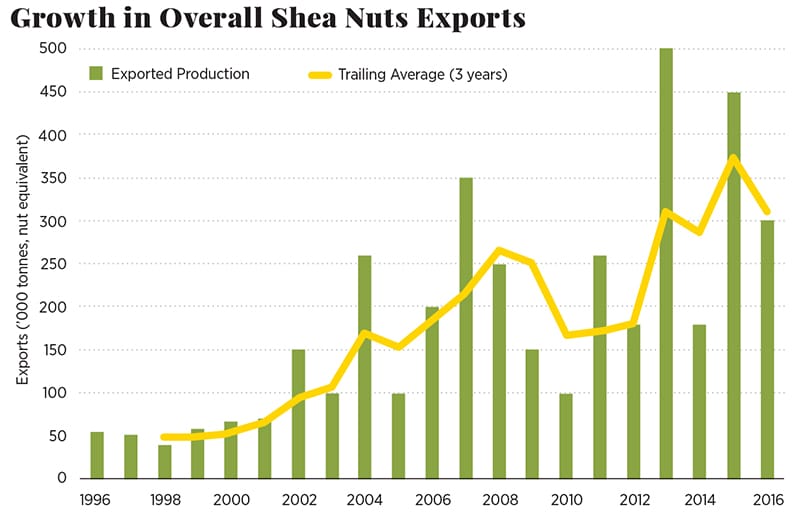
The gathering and production of shea butter have traditionally been not just an economic activity for the rural women of Ghana, but also a social one. Going through the tedious process of breaking open the kernels, grinding them into a paste, and then extracting the butter is something that binds communities together. Gathering at a common place, after their day’s chores, gives the women an opportunity to share their stories, gossip and work together.
Hence, in Mbanayili, where members of the Tungteiya Women’s Association now have a mechanical crusher and grinder to process shea nuts, they still prefer to gather in the afternoons to manually extract butter from the kernel paste. They do this by vigorously stirring by hand large basins full of paste into which they gradually mix warm water this helps liquefy the butter, which rises to the top. The butter is then skimmed off, and heated for about 30 minutes to get a clear oil this is then sieved to remove particle impurities, and allowed to cool and harden into a solid, off-white lump.
“For women in Ghana, this lump is gold,” says Paul. “This has enabled them to have a voice in society.” The Association had started with 50 women members in 1994, and over the years has grown to 640, by providing women with a predictable annual income in a region where there are few other job prospects. “The association also works with about 11,000 shea nut pickers across the northern region, where Tungteiya sources its shea nuts from. These pickers supply nuts to the butter producers depending upon the season.”
The Body Shop’s association with the women of Mbanayili started in 1992, when Anita Roddick, the founder of the company, journeyed to Ghana while making a television programme on women entrepreneurs, and discovered shea. Two years later, in 1994, Roddick placed The Body Shop’s first order of shea through the Tungteiya Women’s Association.
Over the last 25 years, the company has increased the amount of shea it sources to 400 MT a year. It sources it from 11 villages around the town of Tamale in northern Ghana. In return, it supports about 49,000 people in the region through its community trade initiatives that provide clean drinking water, schools and health centres. The company does this by paying a premium (over and above the market price) for the shea nuts they procure. 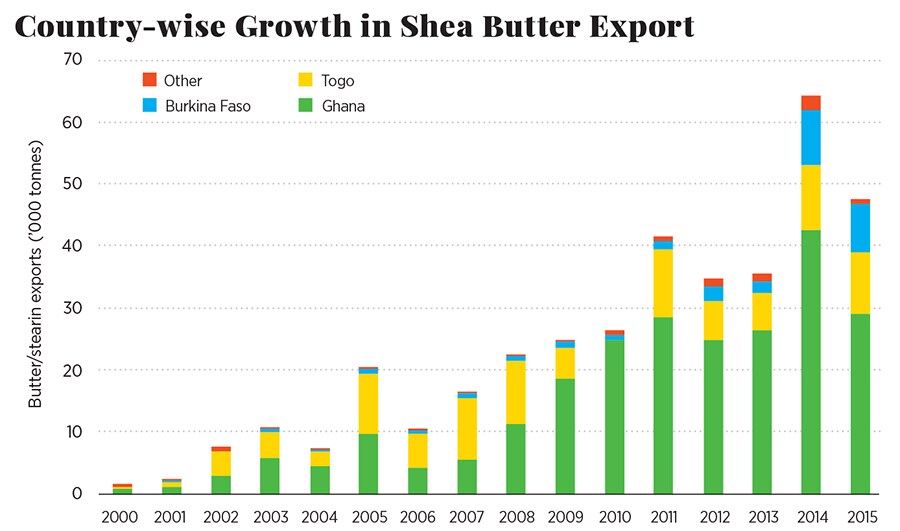
“Change has come to Mbanayili, but it has been gradual,” says Pins Brown, head of ethical and sustainable sourcing at The Body Shop. “There is no revolution going on there. We are simply improving the situation.” Brown emphasises the need to respect traditional hierarchies and work within existing frameworks if improvements are to be made in any society.
The change in the lives of Mbanayili’s women—and, in turn, its children—has also been because of the control they now have over the shea nuts they gather or process. “Earlier, whatever shea they would gather in one season would have to be sold off, even at low market prices, because they had no space to store the nuts,” says Brkic. “If they stored it in their homes, and the homes were fumigated by the government to curb the spread of diseases like malaria, the nuts would get contaminated and would not be usable.”
Through NOGCAF, The Body Shop has built five warehouses in the villages from where it procures shea. The warehouses give the women the option to store the nuts, for up to five years, and the women can choose to make butter from them when market rates are better. “For The Body Shop, securing our production lines is directly related to securing the earnings of the local women,” says Brown.
As the incomes of Mbanayili’s women have become more secure, so have their positions within their families and societies. As the children gather around to watch and clap, the women sing and dance beneath the kapoks to celebrate the light that has already lit up their lives.
(The writer travelled to Ghana at the invitation of The Body Shop)
First Published: Feb 23, 2019, 06:47
Subscribe Now